
Why Visit Gravina di Puglia Near Matera?
Just 30 km from the famous Matera lies its “uglier sister” Gravina di Puglia. Even if it’s so close, tourists generally skip it; many don’t even know Gravina exists, and it’s Matera that they have to tick on their “must-see” lists. Why sisters? Because, like Matera, part of the city was carved into the rock, so it’s somewhat similar to Matera.
Gravina di Puglia lies on the border with Basilicata, and you can reach it either by car or a train from Bari. The car, though, is a better option — I don’t trust Italian public transport at all.
Long history – just in a few words
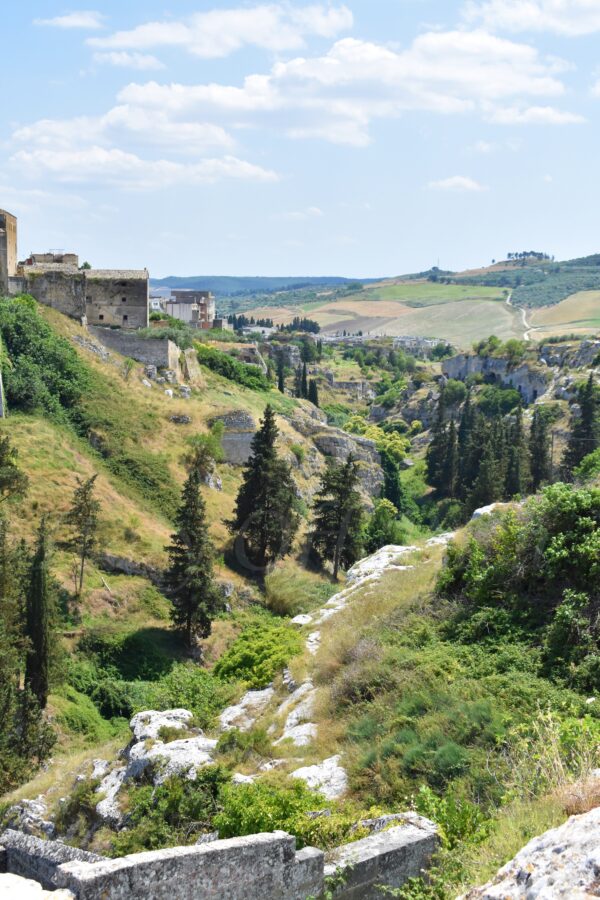
Some sources also describe Gravina as “the city of churches carved into the rock” or “the city of water and stone.” Both descriptions fit the town, which owes its name to the canyon-like fissures in the earth’s crust carved by the river flowing through it over the millennia.
The territory around the city has been inhabited since the Paleolithic period. And like many places in the south of modern Italy, the Greeks were there, eventually replaced by the Romans. In the following centuries, Gravina was invaded by all sorts of tribes and families, from the Vandals through the Templars to the Bourbons; in the end, the town became part of Italy.
Things to Do in Gravina di Puglia: Caves, Canyon and Historic Streets
Even if Gravina is a small town with only 45,000 inhabitants, thanks to its long and “mixed” history, there’s quite a lot to see and do.
I started in a canyon. There is no water anymore (at least not visible), but when it was flowing there thousands of years ago, it helped build civilization and the rock city.
Exploring the Canyon and the Rock Caves of Gravina
Of course, the first humans lived in caves — there are around 80 of them. They modified and adapted the caves to their needs, creating rooms, ventilation holes, and water tanks. Some of the prehistoric ‘apartments’ are accessible, so you can see them inside, which I did.
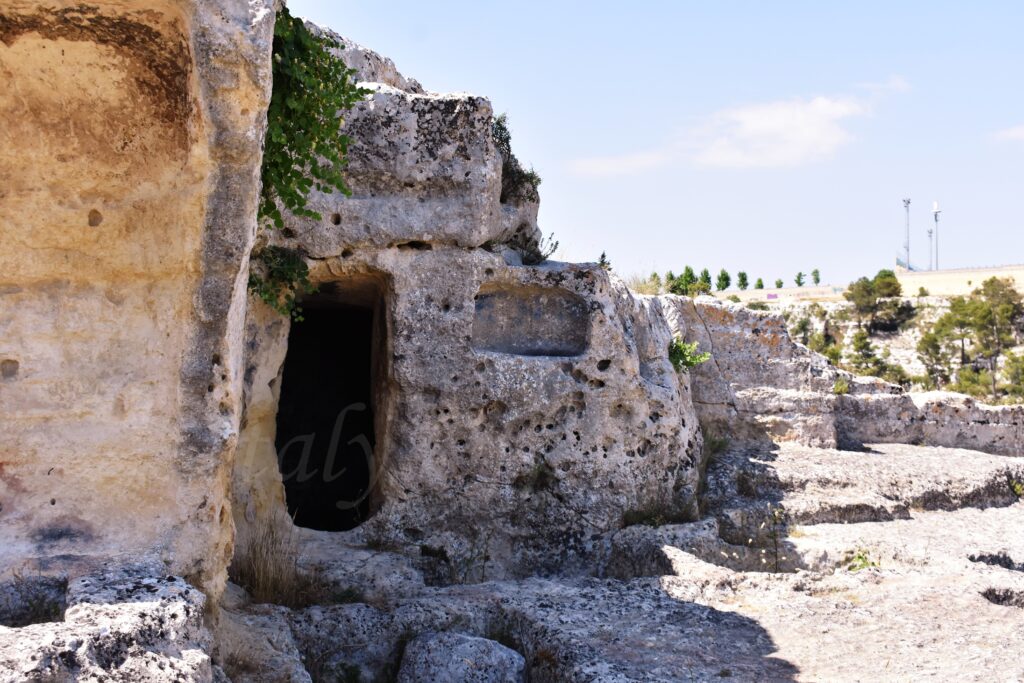
Honestly, exploring the caves, I wasn’t quite sure if, for example, a hole in the wall was a remnant of the handwork of troglodytes or perhaps the result of rock corrosion, but whatever. Walking through the canyon (it was summer), I regretted not wearing long pants; fortunately, none of the crazy vipers that could hide in the grass or bask in the sun on the rocks wanted to meet me. Seriously, there are vipers there, so it’s worth considering closed shoes and long pants when heading to the canyon in Gravina. And maybe something to cover your head, because the sun was really strong.
Ponte Acquedotto della Madonna della Stella: The Bridge from No Time to Die
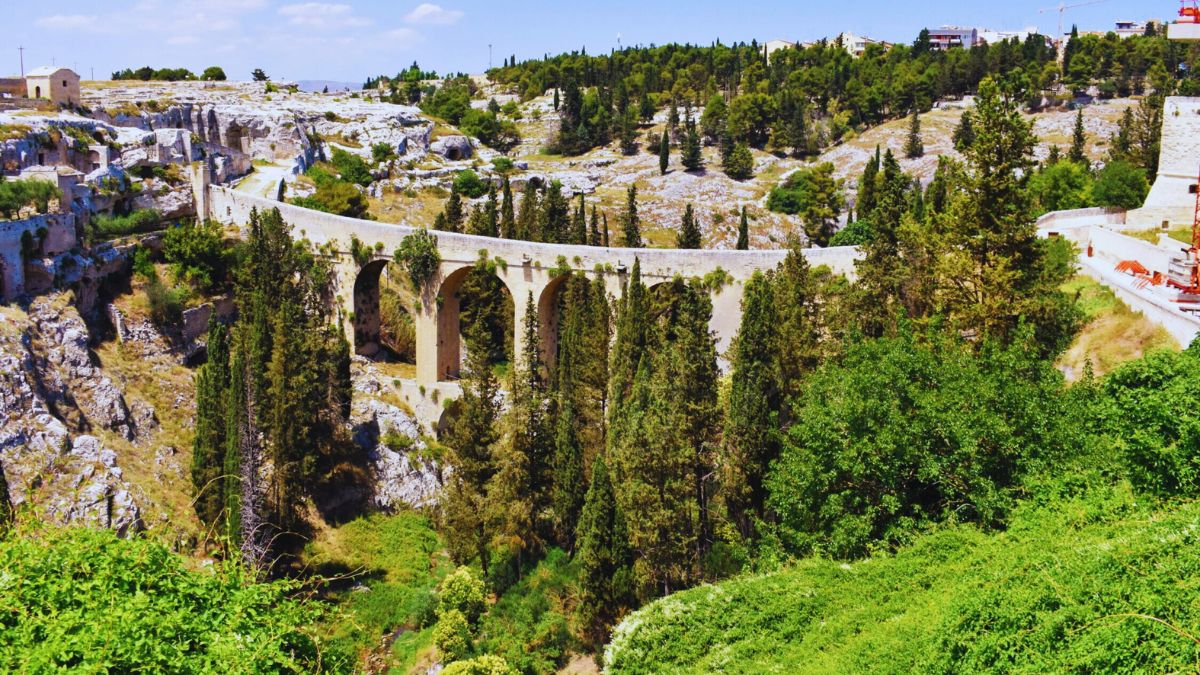
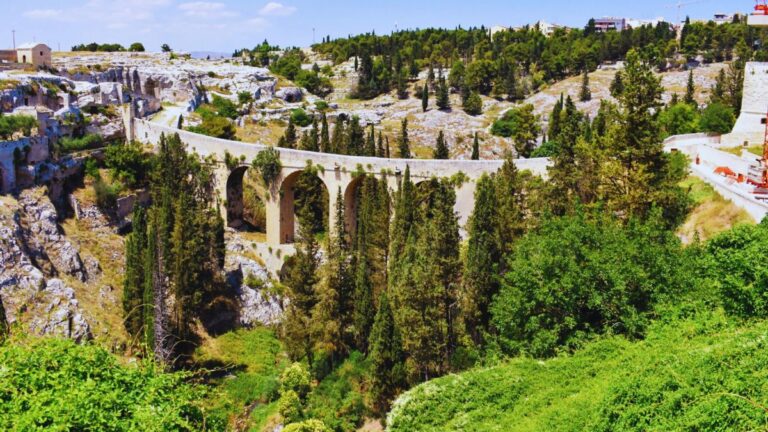
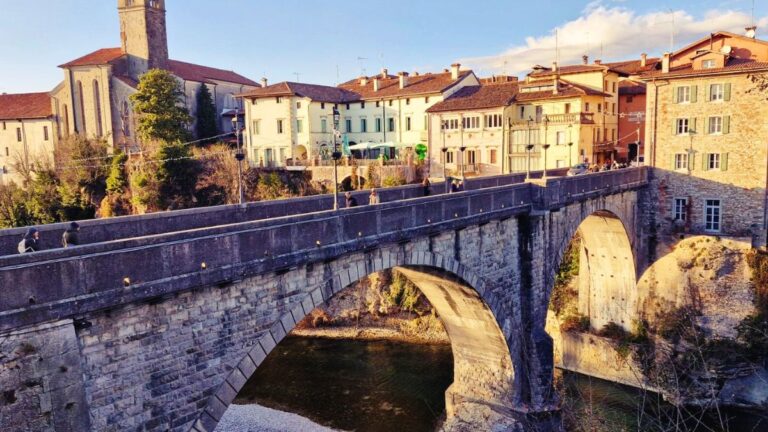
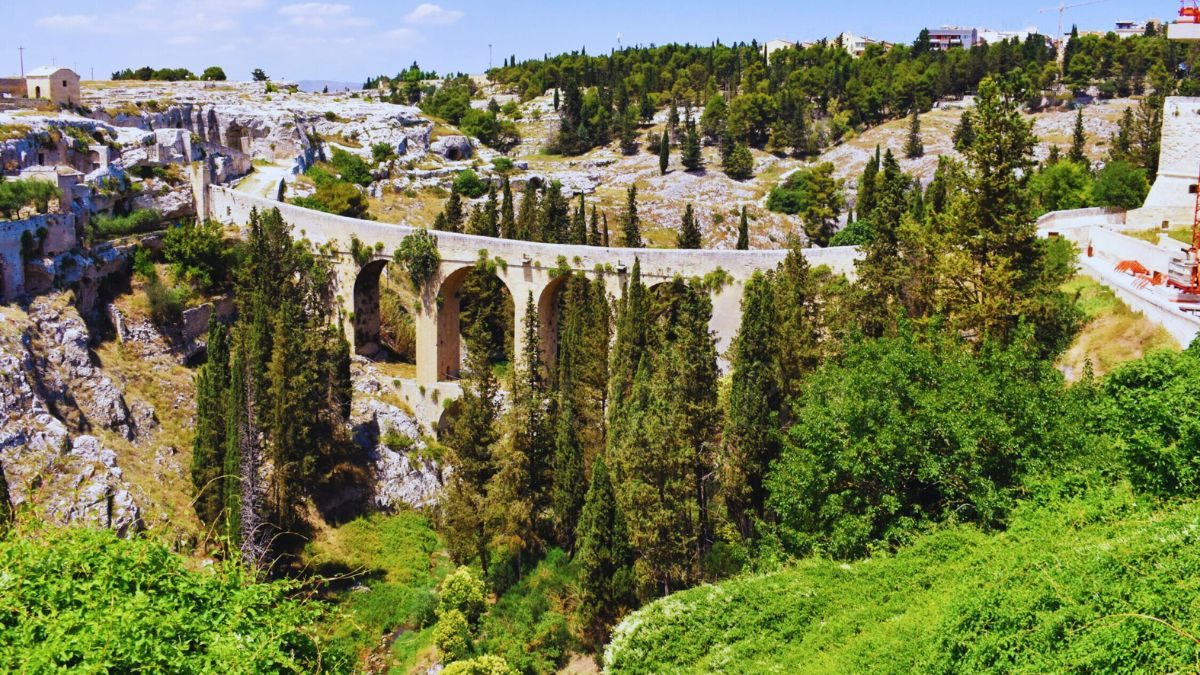
From the canyon, it is impossible to overlook the 90-meter-long bridge with the impressively long name Ponte Acquedotto della Madonna della Stella, connecting both sides of the city. I thought it was a Roman aqueduct, but the bridge is much newer — it was built in the 17th century. After being destroyed by an earthquake, it was rebuilt and transformed and used to supply water to the city, which explains its “Roman” appearance. Now it’s just the bridge. Now it’s just a bridge.
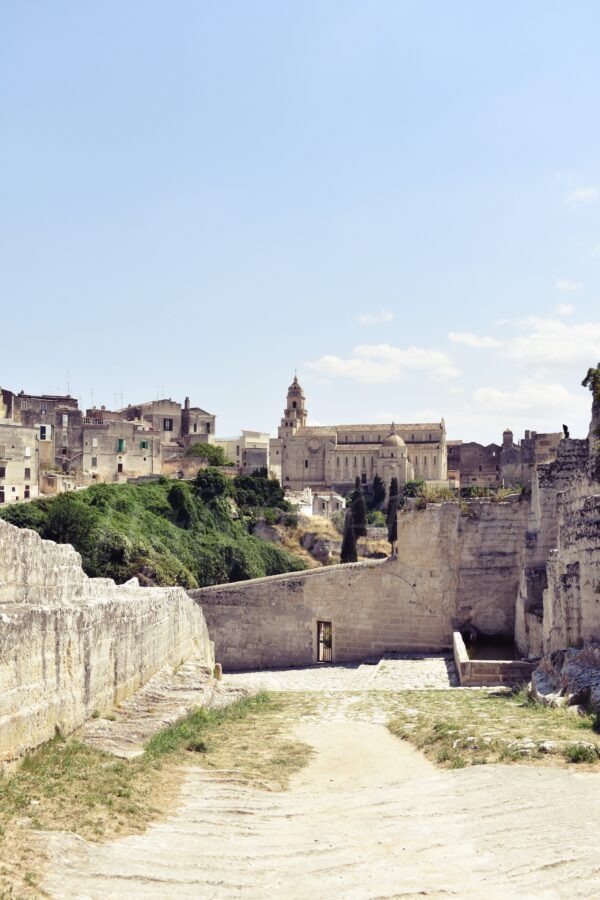
Cross it if you’re curious — it gives you another angle on the town. And if you know Matera, you can compare the two skylines yourself.
What to see in the centre?
After exploring the caves and strolling past the Madonna della Stella, we headed to the old town. The almost circular (at least on the map) area is surrounded by pretty tufa houses connected by staircases and narrow streets.
The old town has some nice buildings, such as the off-white Palazzo Ducale Orsini in Piazza della Repubblica and the salmon-pink Palazzo Popolizio.
Museums in Gravina di Puglia
For such a small town, Gravina has a surprising number of museums — seven. I visited one of them — the Museo Fondazione Ettore Pomarici Santomasi, whose basement houses a church with frescoes.
The museum exhibits dresses, ceramics, coins, paintings, etc. in its beautiful old rooms. One of the exhibits is the sofa used in the Bond film (“No Time to Die”). I haven’t seen the film, so I don’t know which scene it appears in. Bond fans probably know that the film was shot in Matera, except for the scene where 007 jumps off the bridge. Matera doesn’t have such a structure, while Gravina does, so Bond only came there to jump.
Gravina Sotterranea: Visiting the Underground City
I also visited Gravina Subterranea, the underground old part of the city, which houses vineyards, grain warehouses, cisterns, and more. You need to book a visit with the association of the same name. Admission was free (I think it still is), but of course, it’s nice to support the association with a donation after the tour. Was it worth it? In my opinion, yes.
Of course, the city has its own cathedral, built by the Normans. Cathedrals are usually the most beautiful churches in a city, at least in theory, because that’s not always the case. I didn’t see the one in Gravina — as usual in Italy, it was closed (this time because of lunch break); in photos, it looks rather ordinary.
San Michele delle Grotte – Gravina’s Rock Church
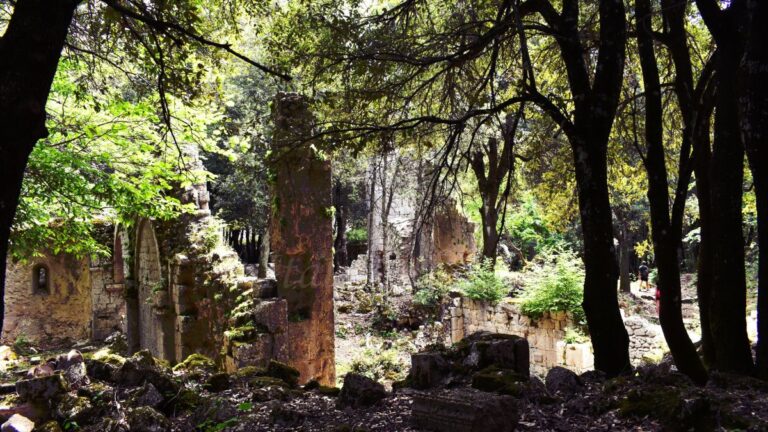
A church worth visiting is San Michele delle Grotte, located outside the center. Its 14 columns and five naves carved into the tuff rock were decorated with frescoes; a few are still visible. There are also three statues and a slightly macabre collection of skulls and bones. In theory/legend, they belong to martyrs from the Saracen attack in 999. In theory. Probably they were collected several centuries later.
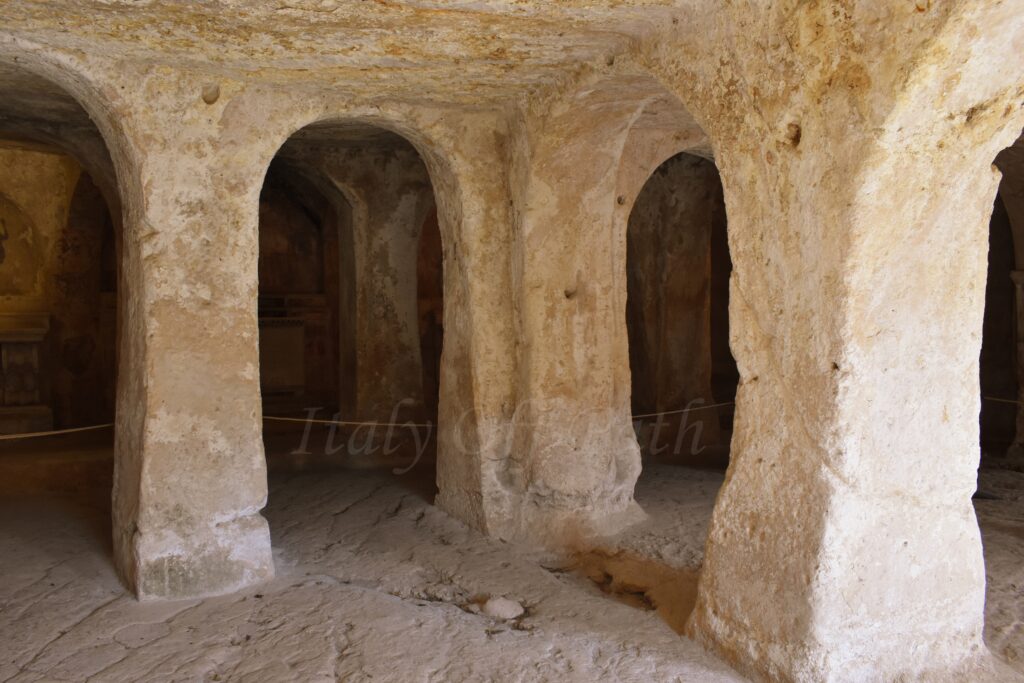
I visited the church with a group of Italians. The priest-guide was excited to hear that I was a foreigner. Delighted, he completely ignored the fact that he didn’t have to switch to English specifically for me. He was about to stand upside down trying to explain everything to me in that language — or rather, in what he believed was English. With genuine enthusiasm, he blurted out individual words he remembered (not necessarily making sense) and looked amazed that he could produce anything. When he got stuck, he simply switched to a very Italian way of communication — helping himself using his hands. Seeing his eagerness to communicate, I simply nodded and smiled.
Where to Eat in Gravina di Puglia: Slow Food and Verdeca Wine
After spending the whole day in Gravina, we got hungry. The town is part of the Slow Food movement; well, sometimes “slow” means exactly what it means, but on the other hand, after a long wait, you’ll enjoy freshly prepared dishes. Assuming you don’t faint from hunger first.
The town has many restaurants and cafes, so finding a good place for lunch or dinner won’t be a problem.
We headed to Trattoria Mama Mia! The name is very touristy, and the trattoria seemed to be rather popular, but we enjoyed our meal, even if we waited for a while. Of course, we tried Verdeca di Gravina — a wine for which Gravina is famous. Verdeca is sparkling, has a greenish color, and a fresh, creamy flavor. It was OK, simply not my taste.
Is Gravina di Puglia Worth Visiting?
I’m always struggling trying to find adjectives to describe cities like Matera and Gravina, because in my opinion, neither is beautiful. However, they are undoubtedly interesting.
Certainly not as captivating or impressive as Matera, Gravina is a bit quirky, very old, and has a unique atmosphere — something between nature and the city. It could be a more peaceful alternative to Matera and a nice place for a pleasant, affordable vacation. Gravina is still authentic, and locals live there. In the evenings, you can stroll through the main square and be the only foreigner, as the town is still not overrun with tourists. The people are friendly, and the weather, as usual in the south, is sunny. I think you could easily spend a few days there.