
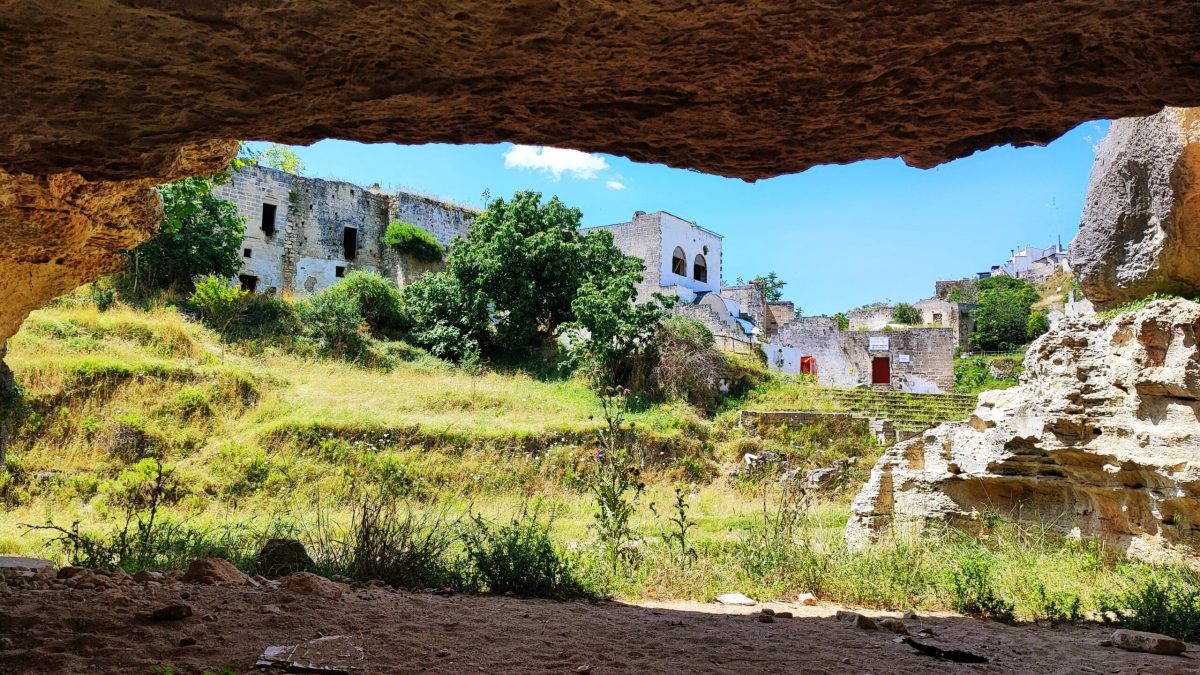
Ginosa – a town located on the border of Puglia and Basilicata- is famous for its troglodyte rock village in the Gravina di Ginosa canyon. It’s just 30 km from Matera, but in this region, no town can compete with stealing all the tourists Matera.
Ginosa is old – not as ols as its famous neighbour, but old enough to remember the Neolithic era, cavemen, Greeks, and Romans who had left traces that can be still seen today
Key Highlights:
- Gravina di Ginosa is a deep limestone canyon in Puglia.
- It features extensive ancient cave dwellings (rock settlements) carved into the cliffs.
- Unlike the restored Sassi di Matera, the Rivolta and Casale districts in Ginosa remain abandoned and authentic.
- Villaggio Rupestre della Rivolta: An organized cave village with over 60 multi-level homes connected by stairs and paths.
- Rock Churches: Notable sites include the Chiesa di Santa Sofia and the Chiesa dei Santi Medici, featuring faded Byzantine-style frescoes.
- Castello Normanno: A 11th-century fortress overlooking the ravine, marking the transition from the cave city to the modern town.
Go to:
What to see in the town.
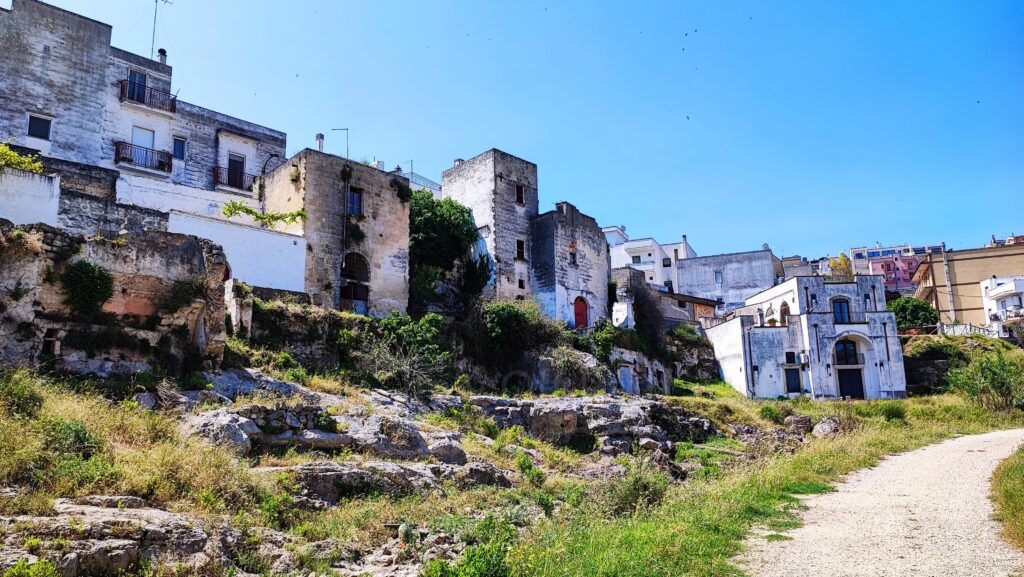
Ginosa is very small, so don’t expect monuments on every corner of the town, as I did. Actually, in the town itself, there are three main ‘antiquities’ to see. Like many places in Italy, Ginosa has a medieval castle – this one was built by the Normans, and then partly transformed into a palace in later centuries.
From the castle, along Via Matrice street, you’ll reach the church of Our Lady of Ginosa, built in the mid-16th century in the Gothic-Renaissance style.
From the castle, along Via Matrice street, you’ll reach the Gothic-Renaissancechurch of Our Lady of Ginosa. You can also see the clock tower in Piazza Orologio, and that’s pretty much it. The main attraction of Ginosa is the canyon with cave dwellings that forms a horseshoe shape and surrounds the city for more than 10 km.
Ginosa Logistics: Parking And GPS Tips
We arrived in Ginosa just before lunch, so finding a parking lot was not easy. The inhabitants were at home eating, and their cars were everywhere. It’s something we do all the time in small towns—arrive late and then waste time looking for a place to park. We finally found a spot on one of the side streets.
In theory, getting to the gorge is easy, but we had to use our friend called GPS.
It led us out of the town to the piers of the bridge. There we hesitated for a moment; unbelievable, but there were no signposts. Relying on GPS, we passed a stone house reminding me of what I had seen in Morocco, and got to the canyon.
Visiting the Rivolta Rock Village in Gravina di Ginosa
Gravina di Ginosa is wide, i.e., the walls are quite far apart, so the gravel and stone road in the gorge is wide. And there is absolutely no shade there; after a minute I was ready to boil. I know it sounds funny, but I’m not a fan of an Italian summer.
I stopped, applied an additional layer of sunblocker so that no rays could penetrate, wore my ugly hat, and decided to see the prehistoric rock-cut settlements in Gravina di Ginosa.
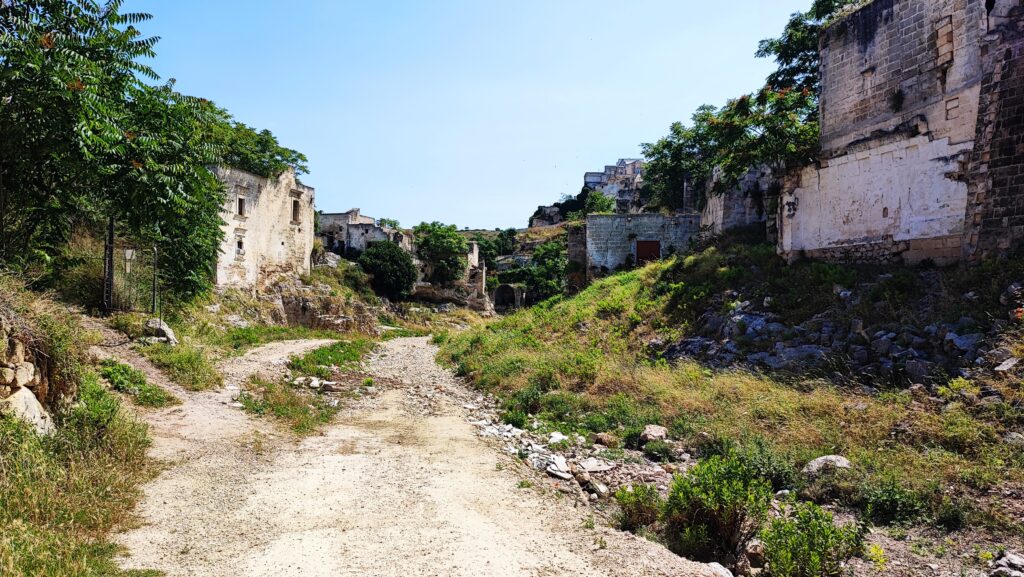
The first ruins are just around the bend. And the first thing I saw before starting exploring them, was a black snake basking in the sun on a stone. These snakes are harmless, but it was a good reminder to watch out, as there might also be vipers.
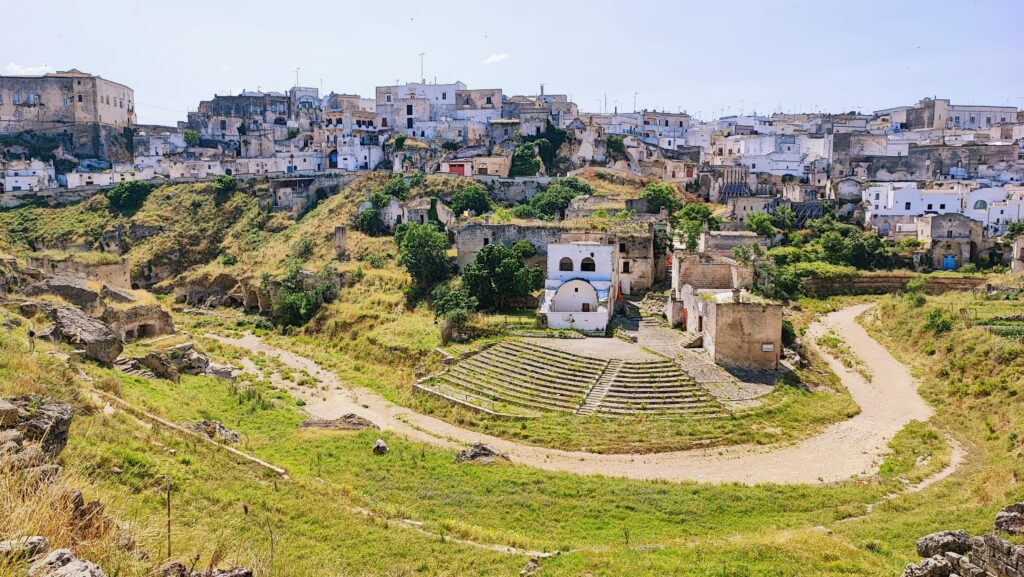
Inside the Gravina di Ginosa canyon, there are two rock villages: Rivolta and Casale -they made the canyon a known spot of Puglia cave dwellings. From the first ruins we still had to walk some hundred meters.
Walking (not so briskly) ahead, we met an elderly man and his bleating company: a herd of goats waving their long, fluffy ears, and politely following their shepherd. He told us that every single goat had a name.
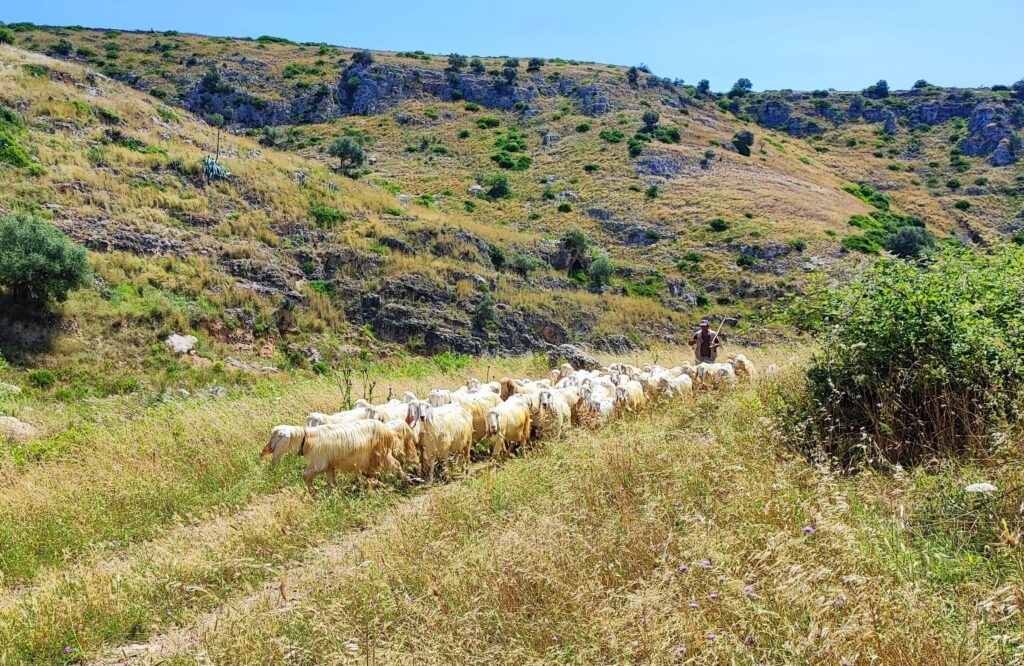
He was even trying to introduce them to us, but the animals were interested in the yellow grass, and not in us. Correctly, hay is better than some dried-up tourists. I love such encounters – learning some funny/interesting things from people whom I will never meet again. But their stories often remain with me.
When we had the Gravina di Ginosa canyon walls in front of us, we turned right and reached the remains of Rivolta rock village.
Visiting the rock settlements: Rivolta and Casal
Arranged on 5 levels, 66 caves carved into the rock were the dwellings of the troglodytes. They also carved a network of stairs between the caves, so if they had parties, going back home was very easy.
All the caves, or rather, troglodyte houses, have chimneys, and some of them also water tanks, stoves, shelves, and cellars. Well, maybe we should verify the meaning of the word ‘troglodyte’; the representatives of this Southern Italy’s cave civilization were not as primitive as the word suggests today.
Another unique feature of the cave houses is the system that allowed rainwater to be collected through channels. The water was directed into the caves and used for cooking, caring for animals, and watering crops. The troglodytes not only built houses, but also cave churches in the settlements of the Gravina di Ginosa canyon: three of them are Santa Barbara, Santa Lucy, and Santa Sofia; it was destroyed by a flood.
Is it worth visiting Gravina di Ginosa ?
In my opinion, the canyon is not a so-called tourist attraction, especially one that can be recommended to everyone. The town itself is average, and the canyon itself didn’t make a special impression on me, just a stone path among rock walls and without a single shade. Ruins are ruins; there are plenty of similar ones in Italy, but the cave houses are interesting as an example of early urban planning.
Are they interesting enough to come to Ginosa? It’s a matter of interests; I probably won’t go there again.
What else can you see in Ginosa apart from the canyon?
You can visit the sandy coast of the Ionian Sea. Marina di Ginosa is a famous seaside resort surrounded by a lush pine forest.
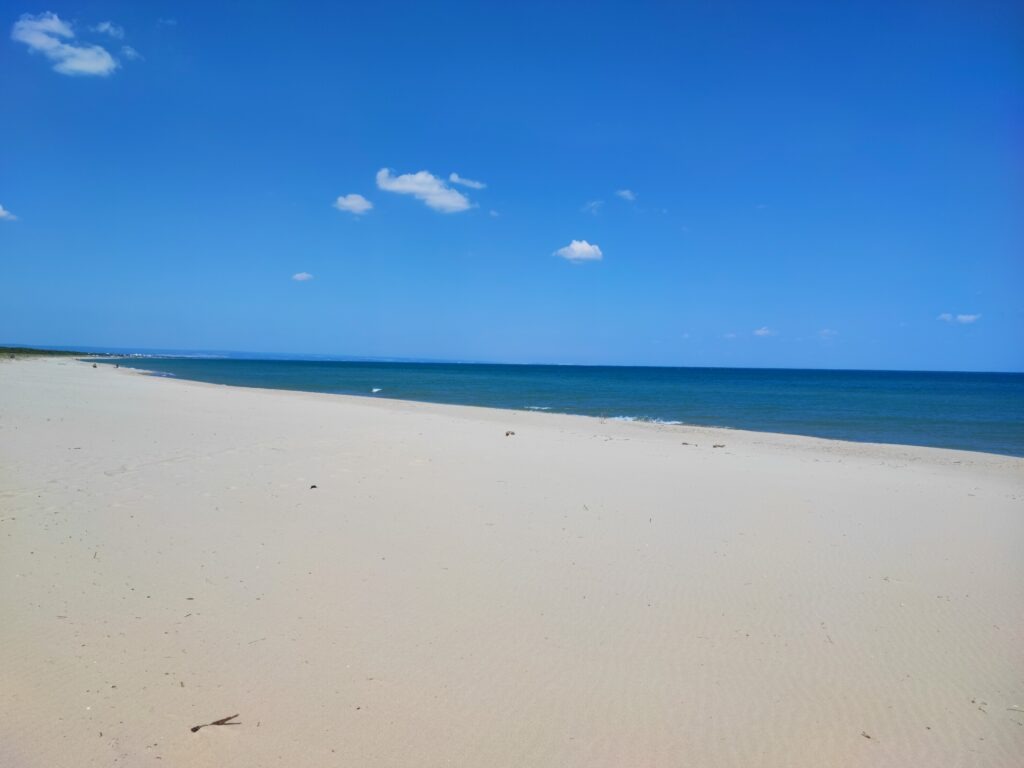
A few kilometers from the beaches is Lake Salinella, located in the Stornara reserve. Also surrounded by a pine forest, it’s a breeding ground for many species of marsh birds. Not far from the lake, since the 16th century, there has been a square tower, Torre Mattoni. Situated on a dune 300 meters from the sea, it served as a watchtower and defense against Saracen raids.
A few practical tips before visiting Gravina di Ginosa:
- A hat is essential, unless you love the sun (I don’t) if you go there in the summer.
- The path is generally easy and flat (except for the approach to the cave houses), but it’s good to have comfortable shoes, because smaller and larger stones can damage your feet
- Take water and apply sunscreen.