
Ever since Mauro first mentioned the name ‘Udine’, I started thinking it must be a beautiful town, something like those tiny places in Slovenia , just with more monuments and atmosphere of Friuli Venezia Giulia. Why? No reason, I guess the name itself struck me as that.

First Impressions of Udine: Reality vs. Expectation”
I was, therefore, happy to confront my imagination with reality. It turned out that it’s better not to visualize places you want to visit. Does that mean Udine is ugly? No, it’s just completely different from what I thought.
We stopped on the outskirts of town and decided to walk to the centre. After passing a few streets and looking around, we came into conclusion, that it’s not the best place to leave the car and we decided to park closer to the centre. And that was a good idea, because I still have a nice image of the city in my mind.
Piazza della Libertà and Udine’s Venetian Architecture”
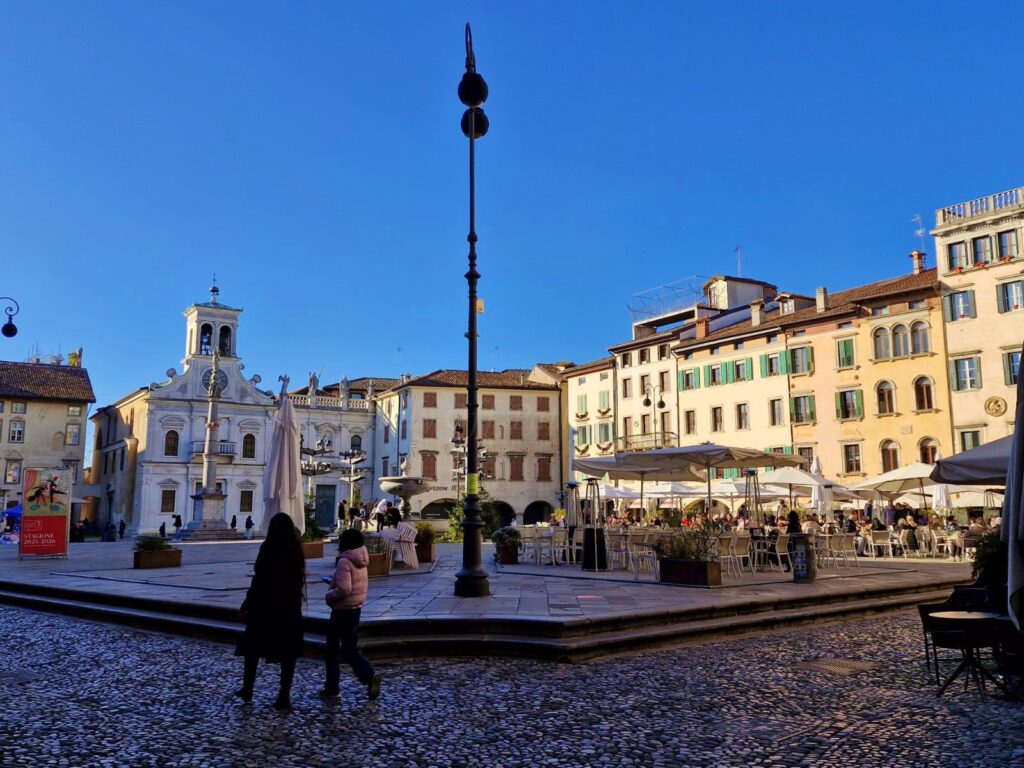
Getting to the centre of Udine through one of the medieval gates, we arrived at Piazza della Libertà, which is the heart of the town. Pretty impressive, as it’s surrounded by striking buildings such as the Palazzo del Comune or the Cathedral of Udine. I really liked Loggia del Lionello with beautifully decorated arches and precisely sculpted columns. Through the arches you can see colourful houses with green shutters; ah…, you can feel almost like in Venice, just without water.

There’s also a huge fountain (Fontana del Carrara), a high column with the Lion of St. Mark – i.e., a Venetian winged lion, a tower with a clock (Torre dell’Orologio), and a few more structures. Walking around the old town in Udine, make sure that from time to time you look up – everything in the square has some beautiful details on the top.
The Cathedral of Udine was open; surprisingly, churches in Italy are very often closed during the week. Duomo (the Church of Santa Maria Annunziata) is old – it was built in the 13th century. Medieval outside and baroque inside create a mixture that, if you like rich and golden interiors and ‘fluffy’ paintings of famous artists, you’d admire it. Regardless of how big names are behind it, I’m not a fan of Baroque art, so for me the cathedral is … too baroque.
Is Udine Really a Hidden Gem?
We were wandering around the old town, visiting other squares, enjoying the mixture of Renaissance and neoclassical buildings; many of them housed cafes, restaurants, and some fancy shops. It occurred to me that calling Udine a hidden gem is an exaggeration – for something hidden, these places were surprisingly busy with locals, and I’m guessing tourists. Well, maybe far abroad Udine is not very well known (I didn’t know it existed), but in Italy and neighbouring Austria and Slovenia, for sure it is.
Udine Castle: The View Worth the Climb
Then we decided to see the castle in Udine. You can climb up or go up in the lift; we discovered it just by chance at the gate in the yard. It took us to the top of the hill where there was a castle that looked like a palace. We enjoyed the panorama of Udine, had coffee in a cafe, and then went down on foot through nice cloisters.

Having the last round around the old town, we came across the market. It was late, but there were two still open stalls with vegetables, and hallelujah, I bought celery roots. I guess celery doesn’t make anyone happy, but it made me. Finding this veggie in the South of Italy (and in Italy generally) is mission impossible. So with over a hundred photos of Udine in my camera and celery in my backpack, we moved to Cividale del Friuli.
Udine and Cividale del Friuli day trip is perfectly manageable, as Udine is not big, and Cividale del Friuli is even smaller.
Cividale del Friuli: A Quieter Afternoon in Friuli
We got to Cividale del Friuli around 2 pm; everything was closed, and there were just a few people walking their fat dogs. Cividale gave the impression of being very well-managed and affluent.
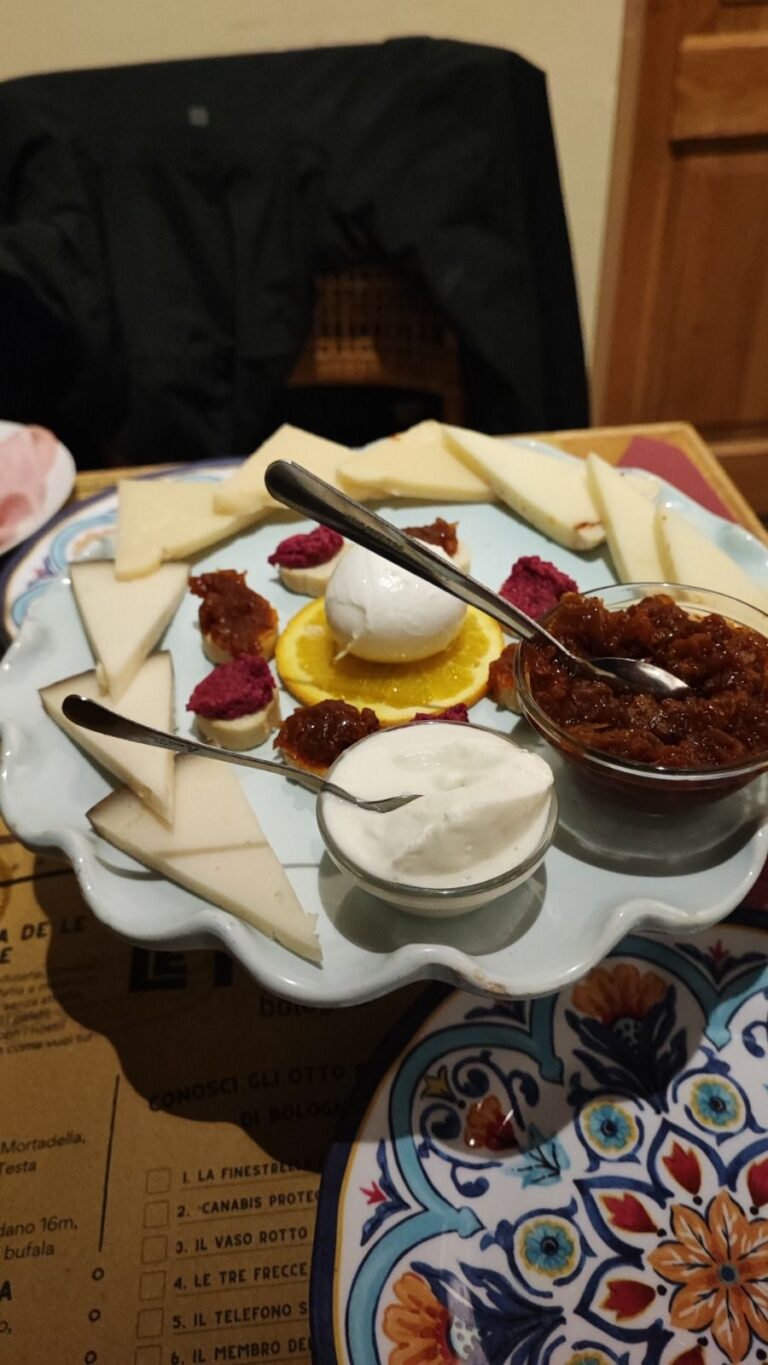
Firstly, we wanted to find a place to eat, but walking around enjoying the street, we finally forgot about lunch. Luckily, one shop was open and offering frico tastings. I don’t know, maybe we looked hopeless (we certainly didn’t look starving), or maybe the owner was having a kindness day for tourists and instead of tasting bites, he treated us to solid chunks of a tasty and crispy potato and cheese dish. Apparently the locals like to feed and that’s why the dogs look the way they do.
The town was the first Lombard capital in Italy, and because of its Lombard heritage, landed on the UNESCO Heritage list. It means that the tourists can admire a bunch of beautiful buildings, squares, and monuments. As good visitors, we did exactly this starting with Piazza Paolo Diacono. With its fountain and cafe-bars it’s a very picturesque spot; I can imagine it’s very lively in the evening. We also saw a small tourist office. Judging by their window, they organize tours in the summer, so it’ll be a good place to go if you need a guide.
Devil’s Bridge and Cividale’s Medieval Character
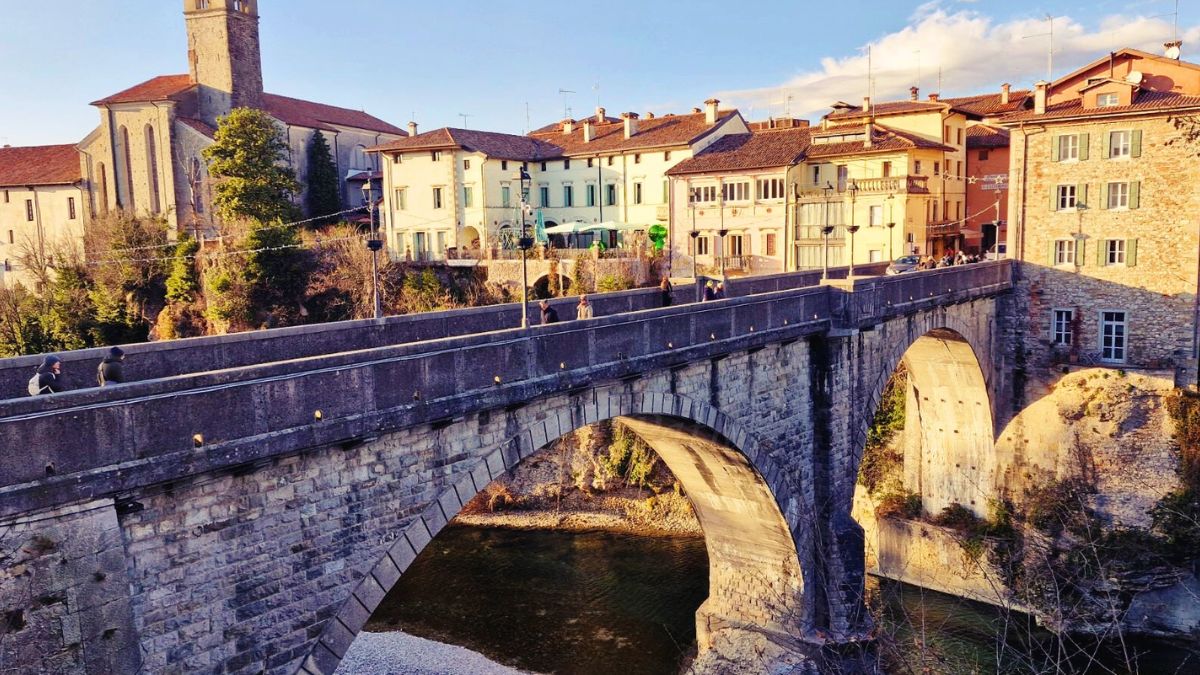
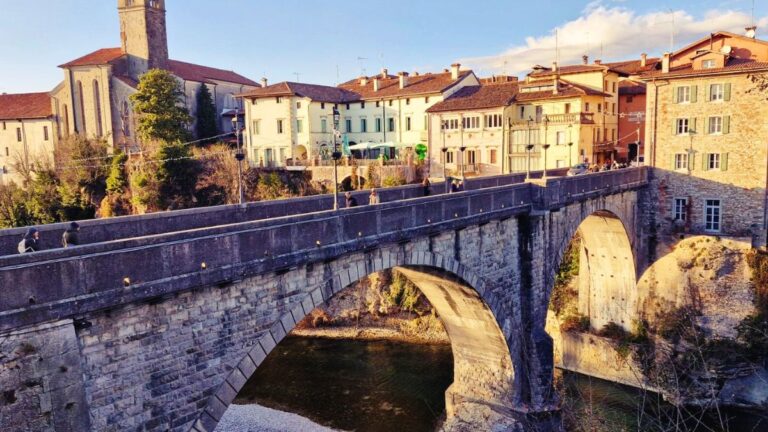
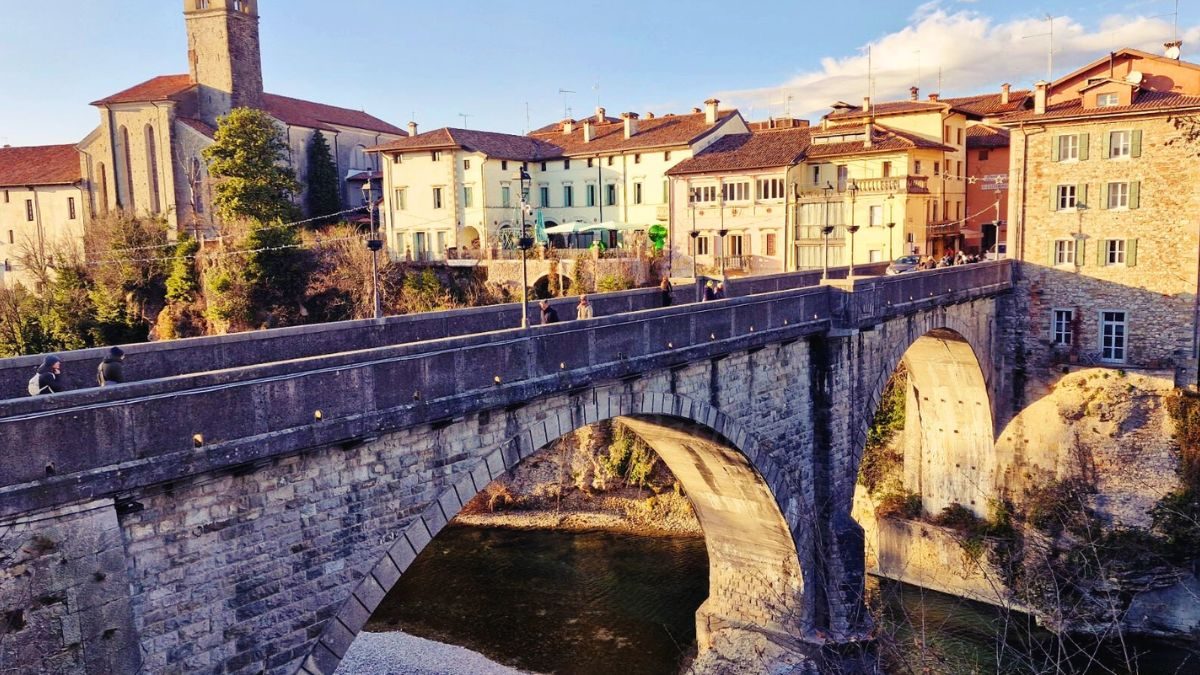
After lunch people started appearing on the streets, and we walked to Ponte del Diavolo (Devil’s Bridge), passing the historic town hall and cathedral; they’re looking at each other from opposite sides of the same street. After crodding the bridge we enjoyed the panaroma: the picturesque town with church towers on top of stone cliffs standing over the river Natisone winding below.

On one of the terraces I spotted huge green balloons. They actually looked like big blown glass balls, and I have to admit that I spent a few minutes trying to figure out the reasons for keeping such a thing at all, and why on the terrace. Whatever motivation was there, the green blobs added a funny accent to the view.
We went down to the river to see the bridge from another perspective – well, this nearly 580-year-old bridge is really a magnificent construction. Looking at its massive spans, I wondered how many of modern-time buildings will still be standing after nearly 6 centuries. I’m guessing not a lot.
Standing on the bank of the river, I stated that maybe Cividale is tiny, but the animals there are pretty impressive: we had already seen fat dogs, and under the bridge, there were equally massive ducks.
The Ipogeo Celtico: Getting the Key from a Bar
We wanted to see the Ipogeo Celtico, translated into English as Celtic Underground. Celts, driven from their homes by the frequency of wars, heavily inhabited northern Italy, so Italians from the North have some Celtic genes.
To enter the underground, you have to borrow a key from a bar called Bar Ipogeo located on the main street, just above the bridge. Yes, that’s right: you have to take the key and open the door to the UNESCO World Heritage Site yourself, pretending to be a curator. Can you imagine, for example, a bar holding the key to the Colosseum? It’s also on the UNESCO list . But then again, it’s Italy, so who knows where the key to the Colosseum is kept. The bar was closed and would be reopened after 5 pm, but we decided to skip the underground.
We were told by one of the locals that the underground is a series of rock chambers carved close to the cliff face. Nobody knows how old are they, why and by whom they were dug. So if you want to become Sherlock Holmes for several minutes, trying to answer these questions, this mysterious spot is for you.
There are some more monuments to visit, in my opinion really worth seeing are the Tempietto Longobardo and the church of San Giovanni Battista. I like Medieval architecture.
Cividale centre is very compact, so actually it’s possible to see everything in the town in a few hours. We spent 3 and a half hours, didn’t see everything, but we saw what we were interested in. I believe it might be a nice place for a longer stay as well. And if you want to splash out, there are quite a few boutiques selling nice clothes.
Visiting Udine and Cividale in One Day: Is It Doable?
Udine and Cividale del Friuli are often called hidden gems. They are not hidden at all, if they’re a gem – that’s the matter of your taste and your definition of the ‘gem’. I liked both places, Udine maybe a bit more. I think it’s more atmospheric, it has more interesting spots, but it’s also bigger, so in a way, it’s easier for Udine to be more interesting. Actually, I shouldn’t compare them; they are very different.
If you asked me which one to see, I would say: in Udine, because of the architecture, you can feel very Venetian-like; in Cividale, medieval-like. And for that, there you can see huge ducks.
If this post made you laugh, made you angry, or simply reminded you of your own mishap, let me know in the comments or by email. I love reading about your experiences in similar places. And sign up for the newsletter – a new post once a week (usually Wednesdays at 6:00 PM). No spam, no “most beautiful Italy ever.” Only authentic events, small wonders, and off-the-beaten-path places. I’m waiting for you!