I never thought I’d regret not being plump. But I did, while spending a day in Trieste, a city famous for coffee and its crazy bora, a strong wind which sometimes blows at speeds of 170 km/h. If you’re slim, well… you’re Mary Poppins flying around without an umbrella. Average people like me have to dig their feet into the pavement, trying not to be moved in a weird direction. Not easy stuff. If you have a lovely belly, good for you! Walk straight and have fun looking at all these bent people in strange poses trying to avoid being swept into the sea.
Getting There & the Hike
While spending two weeks in Slovenia over Christmas, we decided to visit Trieste, as it was more or less an hour’s drive. From Gargano and Manfredonia, where I’m living, it takes over 10 h. Traveling north by car, just for a day in Trieeste, or even for a weekend, would be a bit extravagant. Or crazy.
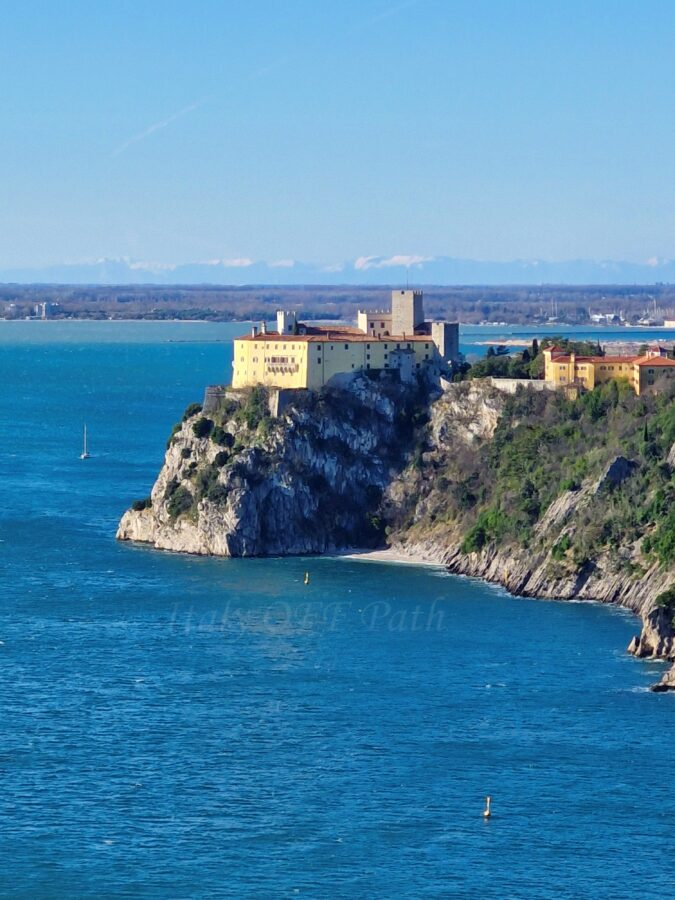
Before exploring Trieste, we hiked the roughly 35-40-minute trail to Duino Castle.
It starts in Sistiana, near the Info Point, winds along the Duino Cliffs Nature Reserve, and ends near the castle. Te trail is easy, with just one or two climbs up a not-so-high slope, from which you can admire a truly beautiful panorama. But because it’s rocky in places, it’s good to wear comfortable shoes. I was wearing smooth-soled winter boots and I could feel the rocks under my feet.
The castle looks nice from a distance and is a private property; there are specific visit times. That day it was closed, what of course was disappointing. But c’est la vie, not everything is accessible just because you want.
Offended at the castle, we decided to walk back to the car sticking to the main road. The GPS showed us a 15-minute walk, which seemed a bit weird and too short to me. And yes, Google Maps was kidding us – we walked much longer. And then we drove to Trieste.
Arrival in Trieste
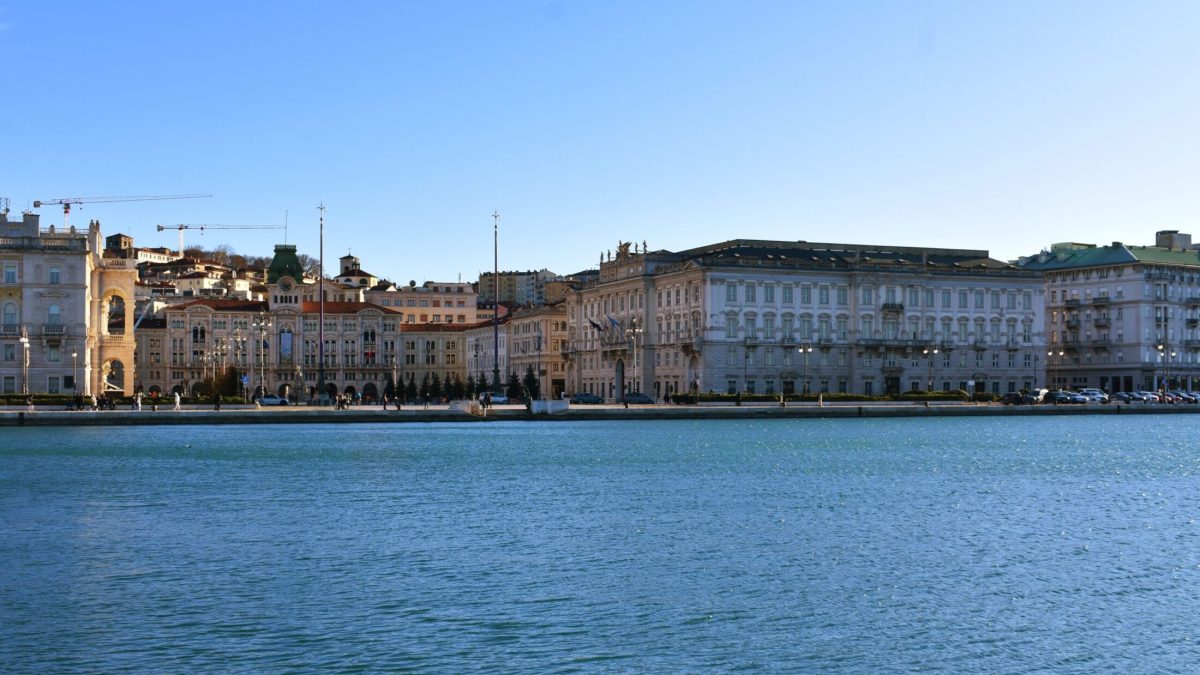
My first impression of the city was – bloody hell, no chance to park. But Mauro found a small spot and left the car – I believe he should have a degree in parking. My second impression was – wow, as the parking lot is between the sea/port and the main square.
From the port, a pier leads down to the sea, and the view is amazing; on the horizon I saw the impossibly blue sea, and in the background the majestic snow-capped Dolomites.
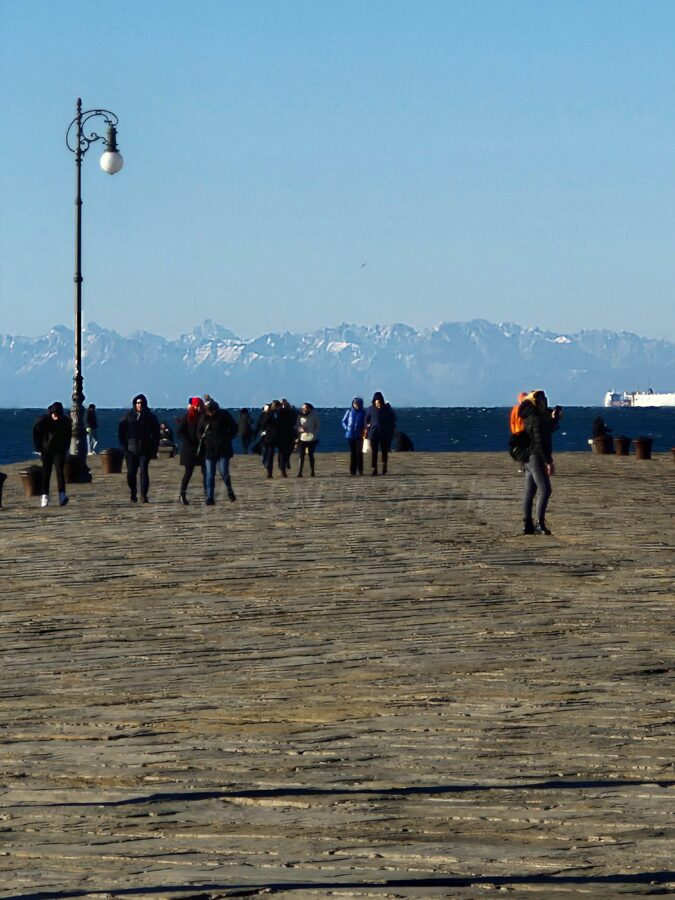
Could there be a better view than that? Well, probably, but this one was simply stunning.
And my third impression was: Such a crazy wind. I’m about to be blown into the sea. In this lovely way I got to know bora. Still on land (fortunately), after mastering the “how to resist the wind” technique, we went to explore the city.
The Austrian Vibe & Quick History
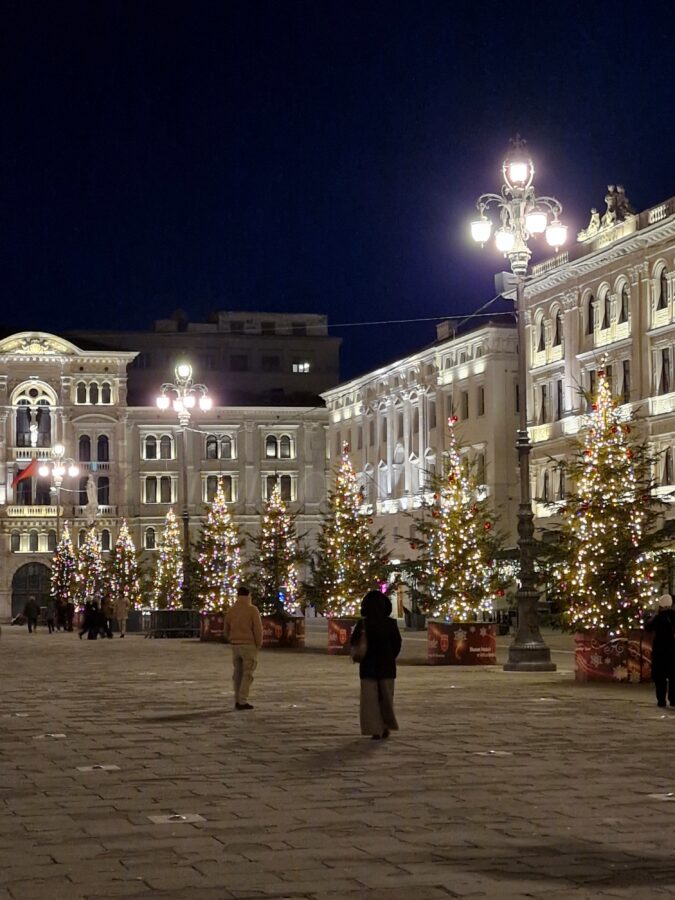
For me, Trieste feels slightly Austrian – and this impression was strengthened by Strauss waltzes played from speakers hanging from lanterns on the main square, decorated for Christmas. It feels so because it used to be a part of the Austro-Hungarian Empire. Actually, the town has an interesting history, so a few words about it.
Besides the Romans and Venetians, other nations also galloped through the city. The Habsburgs settled there for several centuries – this time, thanks to shipping, Trieste became a very wealthy place and one of the most important cities of the Austrian Empire. After World War I, the city was a part of the Kingdom of Italy, then was occupied by the Germans. After World War II, Trieste fell to Yugoslavia, and 70 years ago it was handed over to Italy.
Wandering the City (Random Order)
First, of course, we saw Piazza Unità d’Italia, an impressive square surrounded by the most important and beautiful government buildings. Even if you want to overlook it – no way, because it’s located in the heart of the city and is really big. Look up closely at the buildings – some of them have facades partially nicely decorated with mosaics.
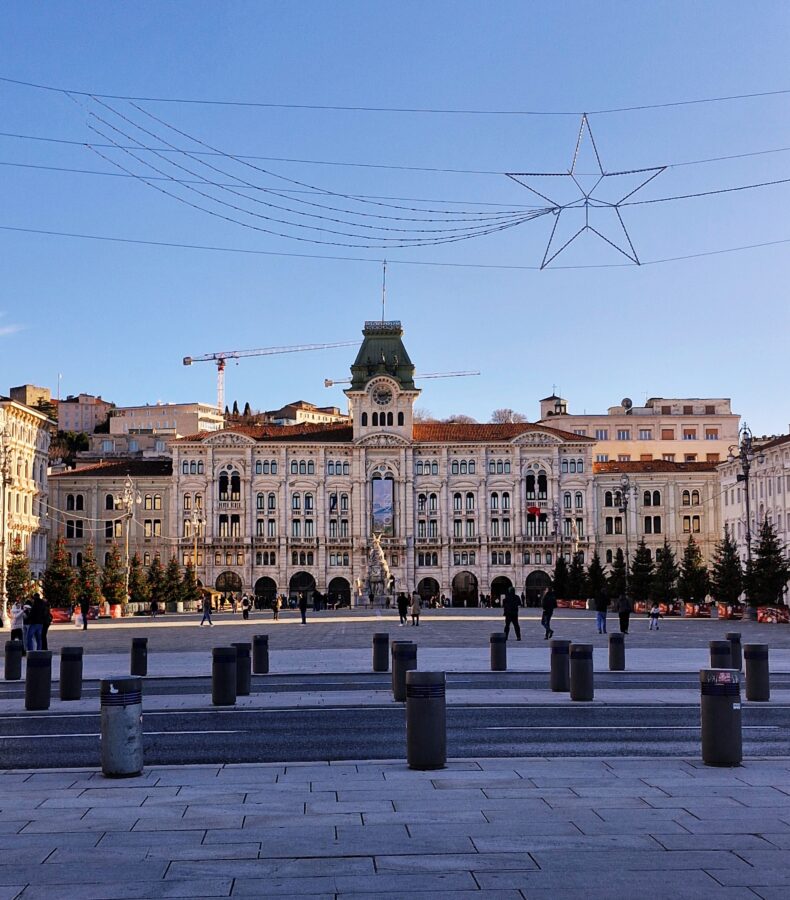
It was 26th December, a time when people are usually in the festive mood; no wonder the bars and restaurants around the square were crowded.
Piazza della Borsa is another nice square, not as impressive as neighbouring Piazza Unità d’Italia, but with a nice fountain featuring Neptune, hundreds of bustling cafes, and stylish shops. And because the square was an idea/project of one of the famous Italian architects, also there I spent some time staring at the buildings, actually at their balconies and windows.
From the Piazza, we moved to the Grand Canal. Well, it’s just a canal, nothing really special, but we still had a walk along it. We decided to have a coffee in one of the bars there, and in there I realized that the buildings might be Austrian-like style, Triestini have a funny accent (which I really like), but the service in the cafe was definitely Italian. We were seated, and then we were waiting, when one of the absolutely unhurried waiters kindly paid attention to us. The service was bad, as it actually is not so uncommon in Italy, but at least the coffee was good. Yes, Trieste is Italian.
At one point during our walk, we came across a strange sight – the Arco di Riccardo (Richard’s Arch).
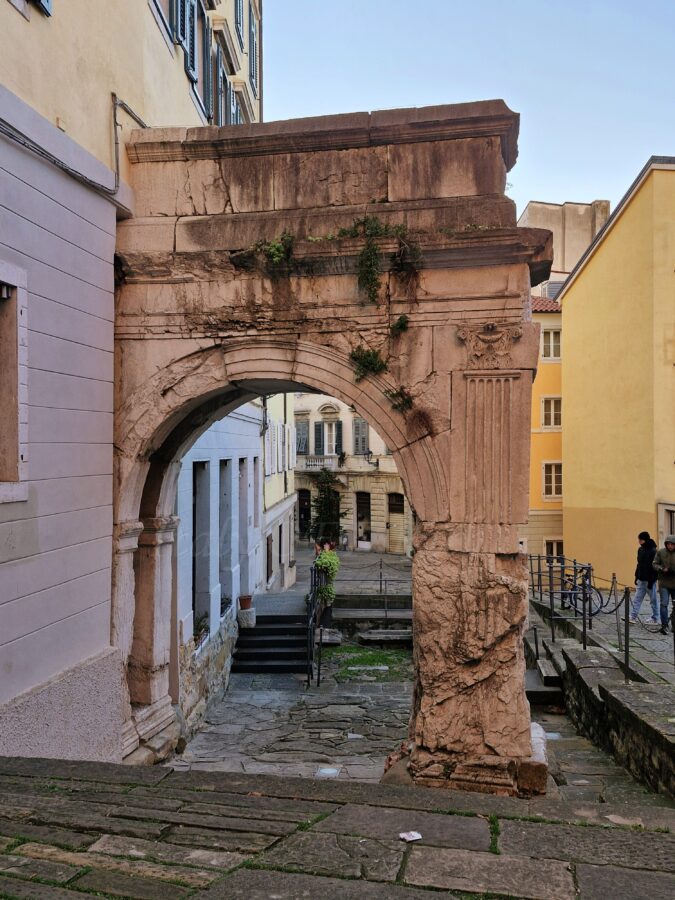
The Roman structure juts out of nowhere from a much newer building on one of the city’s streets, on San Giusto Hill. The monument is 7 meters high and 5 meters wide, and in my opinion, it looks odd, as if it were attached to much more modern buildings. Exactly, as if the arch had been attached to the buildings, not the other way around. On the other hand, at least it survived centuries and wasn’t demolished during Trieste’s urban transformation.
Hilltop Highlights
We also crawled to the castle and the cathedral. Both have the same name – San Giusto – and stand next to each other. Hm, naming both structures the same was clever. You ask someone where you’re going, they answer just to San Giusto. And you have a riddle: the castle or the church. A very good trick helping unfaithful spouses.
We arrived there in the afternoon, and the castle was about to be closed, so we didn’t see it inside. Pity, because with such a history of the town, the exposition in the castle might be interesting. Or maybe I’m wrong. Anyway, the panoramic view from the small square next to the castle is incredible. And since you see Trieste from above, it means you have to climb the hill.
As it was a common practice in the early Middle Ages, the Cathedral San Giusto replaced the early Christian construction. Actually, the cathedral not only took over that site, but it was created by merging two smaller churches. If anyone considers such an old practice destructive, they should visit the cathedral. It’s absolutely beautiful inside: darkish and atmospheric, the altars are amazingly painted and decorated with mosaics. Really worth seeing even if you’re not a believer, as I am. I love churches, and my views don’t clash with my admiration of the craftsmanship of ancient artists.
If you liked the altars in the cathedral, also pop into the little Battistero church.
Coming down the hill, we stopped to enjoy the pinkish-bluish sky and the sea, changing colour with the setting sun. The temperature was rather low, the air was clean, nature could shamelessly boast of its colours. Sunsets are another reason to visit Trieste in winter.
Last Stops
What else we saw in Trieste? The Roman amphitheater – from all sides, as it is located more or less in the center. We ran around it to take pictures and looking at still spectacular ruins.
When it was dark, we decided to enjoy the center decorated with Christmas lights, hoping that maybe the canal would also be nicely lit. It wasn’, but bora reminded us of its existence, so we drove back to Slovenia.
Final Thoughts: Why Trieste Is Worth It
Even if from time to time I didn’t sense I was in Italy, Trieste is Italy. There are these small details, almost crying ‘hey, Italy here’, blended with other styles, cultures, and food. And it makes Trieste interesting. Add curious sights, tiny balconies with decorative railings, mosaics, lazy waitresses, good coffee, and beautiful sunsets, and you’ll know why you should visit it.
If this post made you laugh, made you angry, or simply reminded you of your own mishap, let me know in the comments or by email. I love reading about your experiences in similar places. And sign up for the newsletter – a new post once a week (usually Wednesdays at 6:00 PM). No spam, no “most beautiful Italy ever.” Only authentic events, small wonders, and off-the-beaten-path places. I’m waiting for you!