I’ve probably mentioned a hundred times that I love Abruzzo, so I was really happy to be back on another trip there. This time it was short – just two days — but still better than nothing.
Day 1: Off the Beaten Path in Abruzzo – Discovering Fara San Martino and the Hidden Green River
During the weekend in Abruzzo we stayed in a huge apartment in Fara San Martino. Not only large (in the hall, you could organize car races), but it was also very well-equipped, and from the balcony, we saw the mountains.
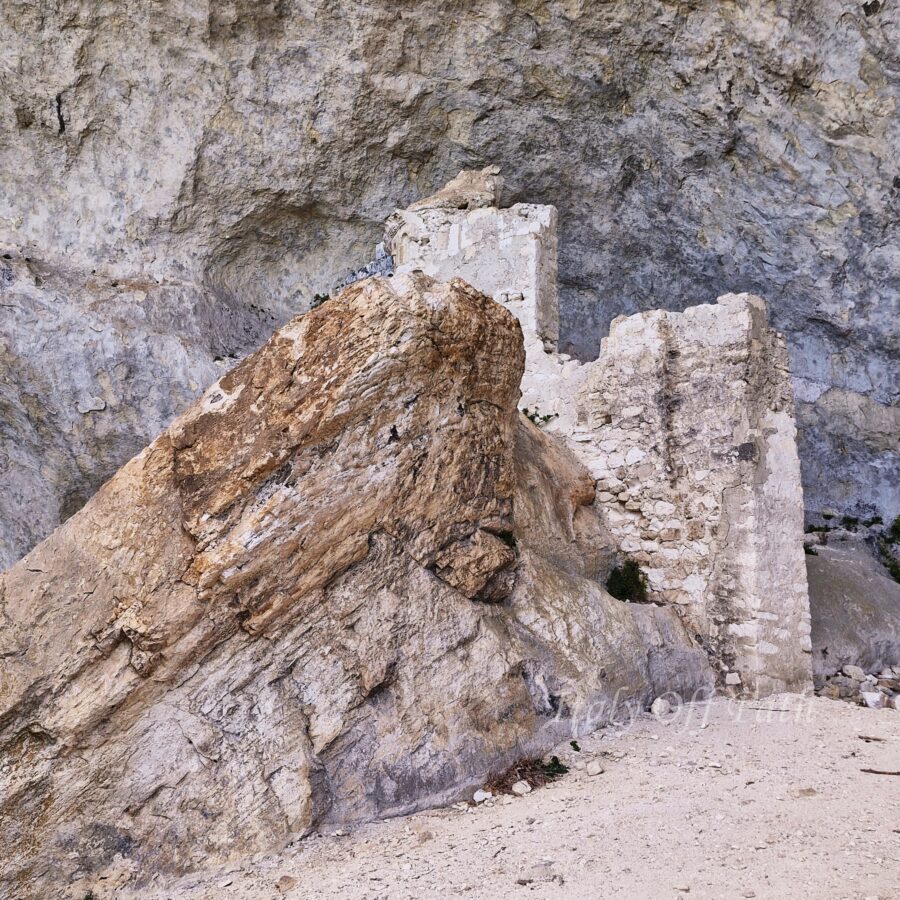
In the afternoon, after a quick shopping trip, we decided to drive to Palombaro to see the stone church of S. Angelo di Palombaro, or rather, what was left of it. It’s on of these rather hidden places in Abruzzo, so I was very curious how it looks like.
Fara San Martino and the Hidden Green River
The hermitage centuries ago was used by pagans to worship the fertility goddess Bona. Times changed, there were no more pagans, so in the Middle Ages, a church was built in its place.
The path to the ruins begins in the forest. Of course, my bear mania kicked in – we were in the Abruzzo mountains, and everyone knows that packs of bears run around and eat people. I still haven’t encountered one, even though I’ve been to Abruzzo many, many times, but who knows when that day will come.
Reaching the hermitage takes about 20 minutes. The path is not difficult, even if some parts are a bit steep, and at the end of it, medieval ruins await. We spent about 20 minutes admiring them, and since the only way was down, we got back to the car. Was it worth climbing to see the church? Well, considering the walk was short, I’d say yes – it was OK. But if I had to climb for more than 30 minutes just to see these ruins, I’d have been very disappointed, to put it mildly.
The road at the foot of the mountains leading to the hermitage used to be a picnic area, but judging by how it looks now, I assume no one ever goes there. I wonder why… maybe it’s because of those legendary bears, which are hard to spot? But it’s quite common in italy – once a popular place now is something off the beaten paths.
The Green River (Il Fiume Verde) – Turquoise Water and an Abandoned Factory
Then we went to see Sorgenti Il Fiume Verde – the Green River. I’d been there before, but it was a long time ago, so we’d forgotten exactly where it was. We stopped where we thought the river should be – and were absolutely shocked by how much it had changed. There was no river – Mauro said that it hadn’t rained, so no the river any more – but then looking around, we realised we had stopped in the wrong place.
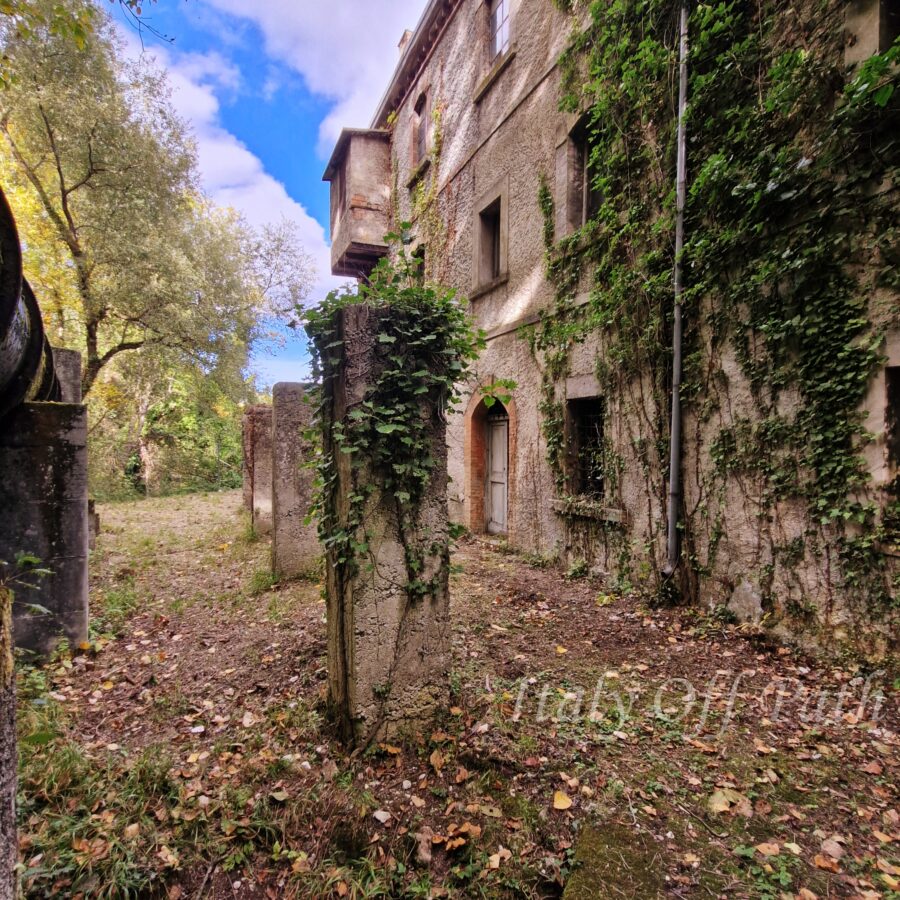
But even thought there was no water, there was a beautiful, old, abandoned house. My eyes lit up because it was overgrown with plants, and I love these houses. And it also had a gorgeous courtyard. I think it was an old pasta factory, and actually,I preferred these ruins to the previous ones.
Then we moved to Il Fiume Verde, which is only a few hundred metres away. The green river is truly green, perhaps more turquoise, and in places almost navy blue. And these unusual features are said to be the reason why the famous Italian pasta brands De Cecco and Del Verde are made in Fara San Martino. Honestly, I have no idea what the colour of the river has to do with pasta, but apparently, there is something to it.
Gole di San Martino – Ruins, Trails, and a Bit of Nostalgia
After a short walk along the river, we moved on to the Benedictine abbey at Gole di San Martino, a place where you can go along the river towards the mountains. According to historical records, the abbey was founded in the 9th or 10th century. Local legend has it that it’s 300 years older.
It seems that we had a day of ruins, as the abbey is also in pieces , ie ruined, and it’s located in a very picturesque setting. If you’re up for a hike, there’s a nice trail there.
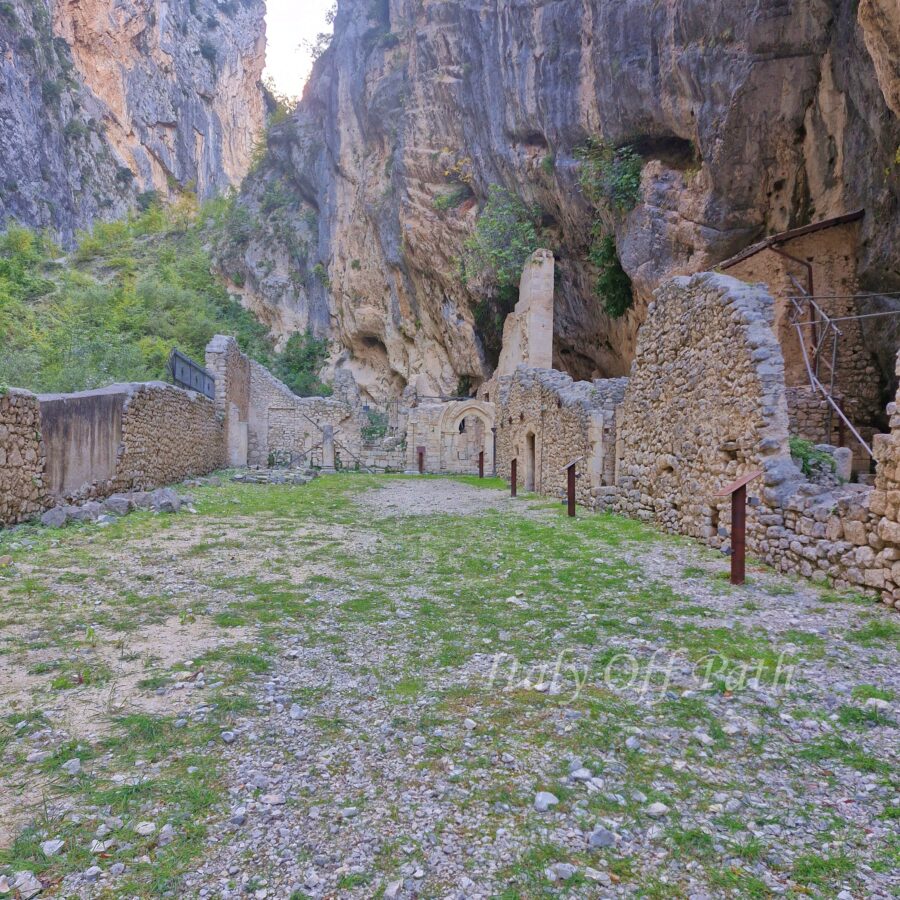
Quite a lot has changed since my first visit to Fara San Martino. Parking was originally free, but now you have to pay, although it’s also much bigger. Years ago, there was a smiling road sign, i.e., a normal sign with eyes and a smile painted on it, standing in front of the entrance to the gorge, welcoming visitors. Unfortunately, it has been replaced by a normal sign. The abbey, or rather the ruins, haven’t changed at all, nor have the surrounding mountains.
We also had a short hike (the view over the abbey is better from the top), and that was the end of the first day in Abruzzo.
Day 2: Off the Beaten Path in Abruzzo – The Grotta del Cavallone Cable Car Experience
On our second day, we planned to visit the Grotta Del Cavallone, the highest cave in Europe. Since guided tours run hourly, we had some time, so we popped into the Logetta Sacrario. Climbing up, we reached the loggeta, a path carved into the rock used by soldiers during World War II. Again, I wouldn’t have gone there specifically to see the loggeta, but because it was on the way, so that’s fine.
A Basket Ride Up the Mountain – Fun, Fear, and Stunning Views
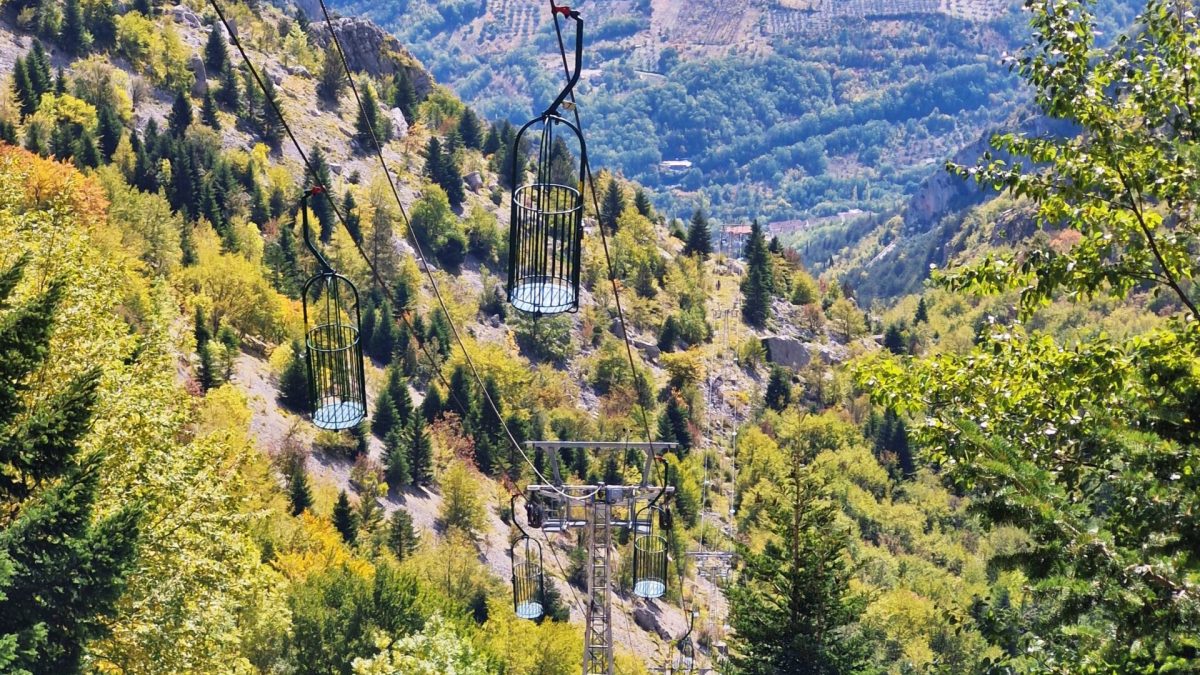
Then we went to see the cave. The ticket costs 27 euros per person, and you first have to take a cable car up the mountain. And here I was a bit hesitant – I don’t trust anything high up in Italy (this is after several famous accidents where something fell, e.g., a bridge or a cable car), so I felt a bit uneasy for the entire 20 minutes, as the journey in the historic (!) basket took that long. The carts look like large baskets (for me, they seemed like huge hampers for eggs or chickens), which I didn’t particularly like.
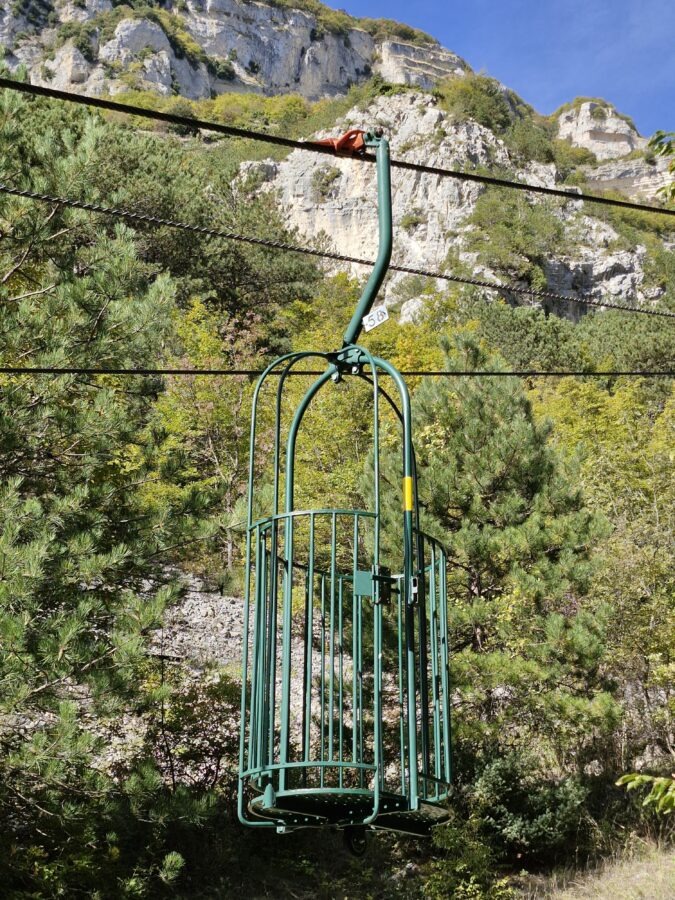
But I kept telling myself that if we fell down, it wouldn’t matter whether we were in a basket or a more sophisticated cabin. Getting on and off the carts is like a game: the carts don’t stop (the staff just hold them for a few seconds), so you have to hop on and then hop off while the cart is still moving. Well, it’s an extra adrenaline rush. Anyway, the views from the basket are fantastic, as you can admire a magnificent 360° panorama of the Taranta Valley.
Mauro did it, wriggling here and there, which annoyed me, as I was a bit panicking. If, like me, you don’t trust such hanging things in Italy, there’s also a trail leading to the cave, which takes about two hours.
After reaching the top and jumping out of the basket like a mountain goat, we went to a café to get our helmets. You can also download a code there, and read in English everything the guide says about the cave, as the tour is in Italian.
To get to the cave, we walked on a gravel road leading slightly uphill, then we took 300 stone steps.
Since I prefer climbing to descending, I made the climb quickly. Although I was out of breath, I was on the top of the stairs, so whatever. Still, I watched with satisfaction as much younger people scrambled up the hill, stopping every minute to catch their breath.
I wondered how the staff feel about traveling to work like that , but it’s probably a matter of habit: some commute using cars or public transport, while others do it in baskets suspended from cables.
Inside the Cave: History, Stalactites, and Italian Noise
The cave is enormous and, like all caves, full of stalagmites and stalactites in sometimes weird shapes. You can expect that places like that would be quiet… but no way, Italians can’t be silent, it’s simply against their nature. So the cave was filled with whistles, whispers, chatter, and other sounds produced by them. And the guide’s booming voice. According to him, during World War II, people hid in the cave to avoid Allied bombing. They wrote memories and wishes on the wall; their notes are still visible.
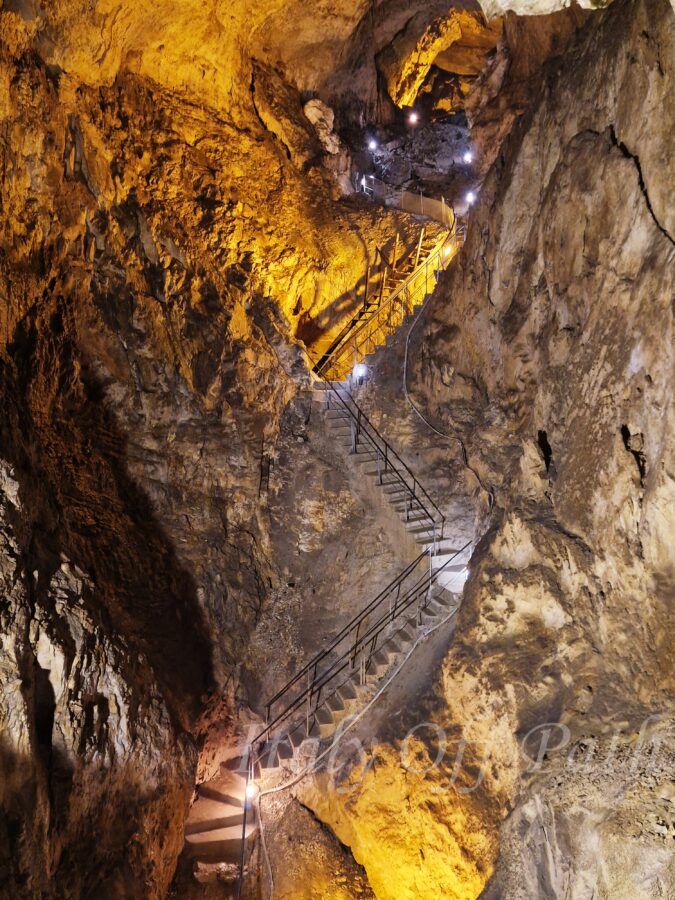
The hiking trail in the cave is quite wide and generally easy, but it can be slippery in places. Steep stairs lead to the last room in the cave, which contains a 27-metre-deep hole, but the guide informs that you can wait if you don’t feel like climbing. And that’s where the one-hour tour ends, and all that’s left is to go back and jump into the cage/basket to go down.
Grotta del Cavallone – What to Know Before You Go
- Temperature in the cave is constant – 10°C. and it’s humid inside, so wear something suitable.
- Wear sturdy, non-slip shoes; do not wear open-toed or rubber-soled shoes
- Take water with you