
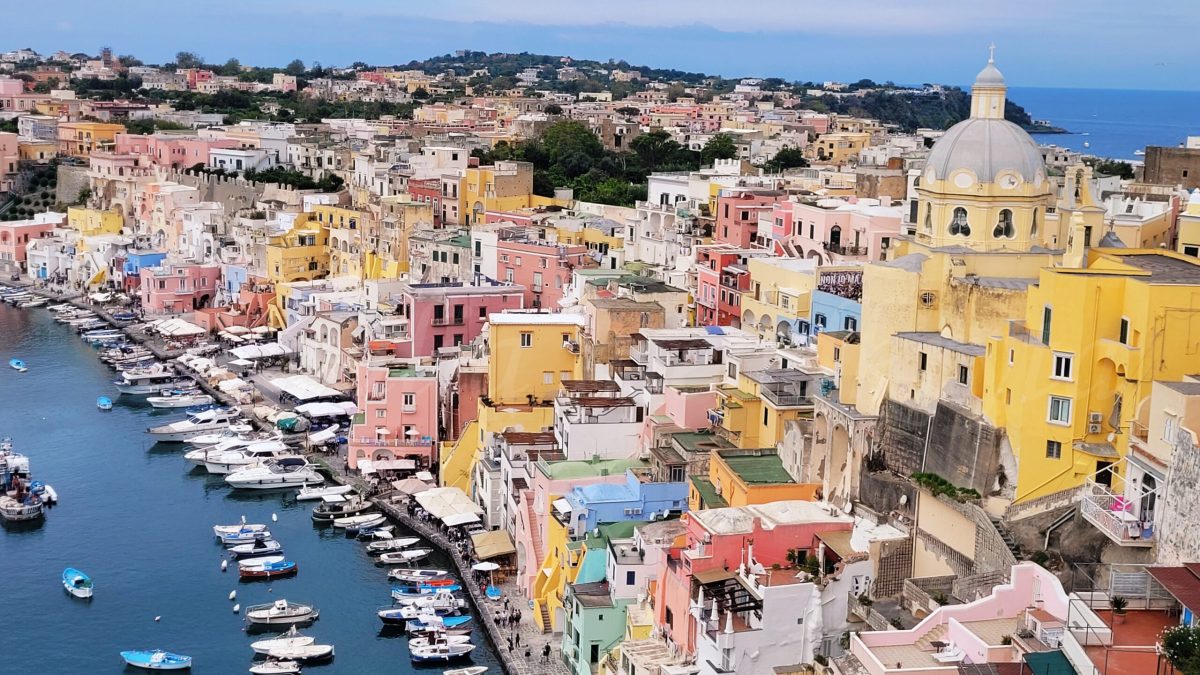
I first visited the island of Procida, the lesser-known sister of the famous Capri, 10 years ago.
Back to Procida After 10 Years: What’s Changed on Italy’s Colourful Island
After all this time, on a beautiful October day, I decided to return to see if anything had changed in Procida Island, Italy – this once-peaceful place. And yes, it had.
But before we went to the island, we dropped in Benevento, and then we drove to Pozzuoli, where we spent the night. We left early in the morning, even though the ferry was at 10 a.m.
Since it was a beautiful October Sunday, Mauro predicted that the islands would be busy, with crowds at the port and queues for tickets. And he was right.
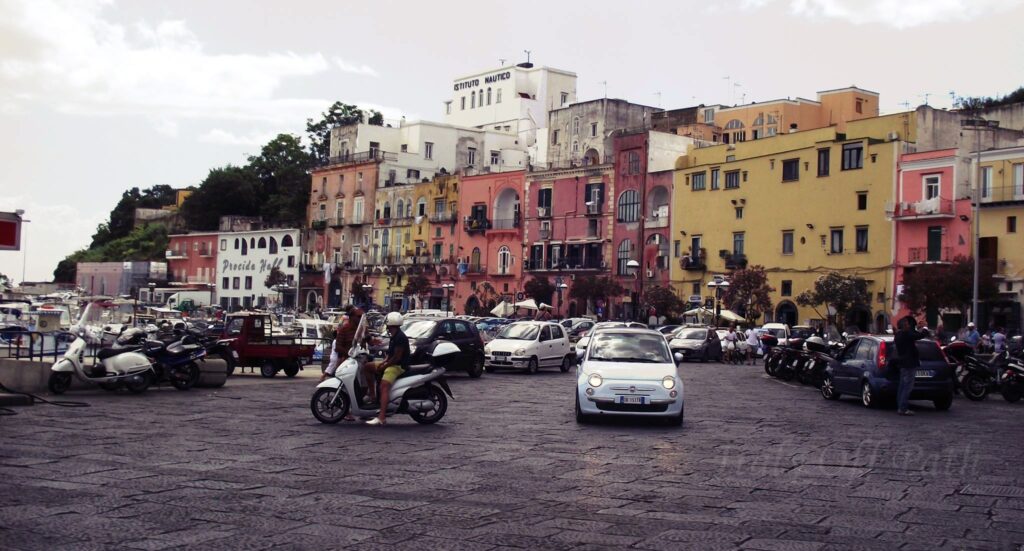
A Short Story About Parking (and creativity)
Finding a parking space in Italy, especially a free one, is always a challenge. Southerners are always trying to avoid paying for it.
That’s why when we found free parking near the port the previous evening, Mauro was over the moon. In the morning, however, a black (it’s not always a rule) self-proclaimed parking attendant was waiting for us there. This is a common practice in southern Italy: in a free parking lot, someone suddenly appears and “lets” you leave the car for a small fee. It’s illegal.
I know that with this unemployment rate in the south, people are trying to make some money, but I honestly don’t care. The more that forcing fees is often linked to the mafia, and actually, for me, free means free. Italians generally gladly pay in such situations and then complain.
The “valet” really irritated me, so we had a rather unkind chat, but we parked anyway and went to the port. Mauro was a bit worried about the car, so I suggested complaining to the police at the port.
And what did the police say? Not a lot. They shrugged, said they knew about it, and advised us to move our car near the port. So we did. The self-proclaimed parking attendant didn’t get a penny from us; when we were leaving, he was throwing insults and small stones at us.
So if you see a guy at a free parking lot who wants money from you, you have two options: either pay or find parking somewhere else.
How to Get to Procida Island by Ferry (and What to Expect on Board)
As with all islands, you can get there by ferry, hydrofoil, or other means of sea transport from Naples, Pozzuoli, Ischia, or Capri. You can also sail from the Costiera Amalfitana, but in this case, the journey is longer. All ferries arrive at the main port of Procida.
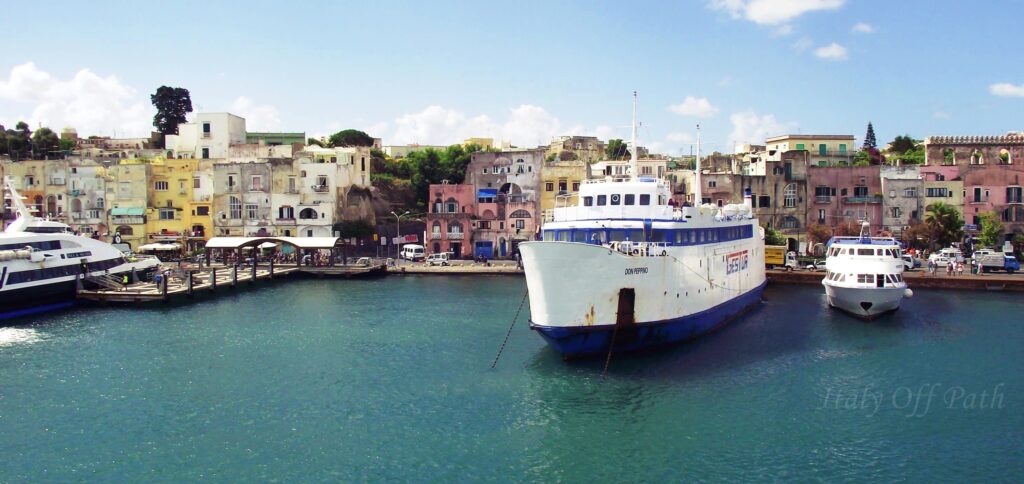
In Naples, ferries of several operators depart from the port of Molo Beverello. Generally, the Naples–Procida Island route will take about an hour; depending on the operator, it may be longer or shorter. Some ferries sail further than to Procida, so listen to the announcements. But don’t worry if you don’t hear one and miss Procida — the other islands are also beautiful.
In Ischia, the ferries depart from Ischia Porto or Casamicciola, and the cruise lasts about 20–30 minutes. And again, Procida doesn’t have to be the final destination. The return journey is slightly longer due to the currents around the Bay of Naples.
We went from Pozzuoli, and it took 30 minutes to get to Procida. You can buy tickets at the ticket office in the port, or online. The afternoon return to Pozzuoli was sold out, so we had to go back to Naples. That’s why it’s worth getting tickets in advance, especially in the high season, to avoid a surprise like we had in Naples.
We visited Procida in October, and the ferry was packed. I thought most of the people were going to Capri, as it was 10 years ago. Back then, we were almost the only foreigners among the passengers, and maybe 10 people got off in Procida, including me and my ex-husband. This time it was completely different. I think 99% of the travelers on the ferry were Italians — 95% got off in Procida.
A (Very) Brief History of Procida Island, Italy.
Procida doesn’t particularly differ from other areas of present-day Italy — in the sense that various tribes and nationalities passed through it.
According to archaeologists, it has been inhabited since the 16th century BCE. After Greek rule, the Romans arrived — so the Roman elite had a place where they loved to relax and enjoy various ancient pastimes.
In following centuries, the island was frequently visited by people more or — usually — less friendly to the locals, such as Saracen pirates.
In more recent times (still very historical, though), the island fell into Spanish hands, then Austrian, then French, and finally became a part of Italy.
Walking, Buses, and Bikes – How to Move Around the Island
The best option is to use your feet, as Procida is small. Although it’s located in an area of volcanic activity and is hilly, which means that the island’s streets run up and down, and there are a lot of steps. But that doesn’t bother me — I like walking, and you can treat it as a free gym.
At a brisk pace, you can walk the entire length of Procida in just over an hour.
Minibuses:
Ten years ago, there was no public transport in Procida, so it’s cool that there is now. The electric minibuses operate on four lines and depart every 30 minutes from the Marina Grande port. A 60-minute ticket purchased at a bar, kiosk, or Caremar ticket office costs €1.20 and €1.40 if purchased from the driver (prices may have changed since my last visit).
Taxis:
You can find them at the port. Prices may vary depending on whether it’s high season or not, so it’s better to ask how much the service will cost before using it.
Bikes:
There are bike rentals on the island, which provides you with a great option — i.e., exploring Procida by bike.
What to See in Procida
My first impression after 10 years was that the port had changed a lot. Now there is a bike rental, lots of cafés, and signs in English. There are also minibuses, taxis, and many more souvenir shops. The tourist boom was visible at first glance.
Of course, you can spend the whole day at the port, but I don’t think anyone would come to Procida just for it.
San Antonio, Piazza Olmo, San Giacomo
The Heart of the Island
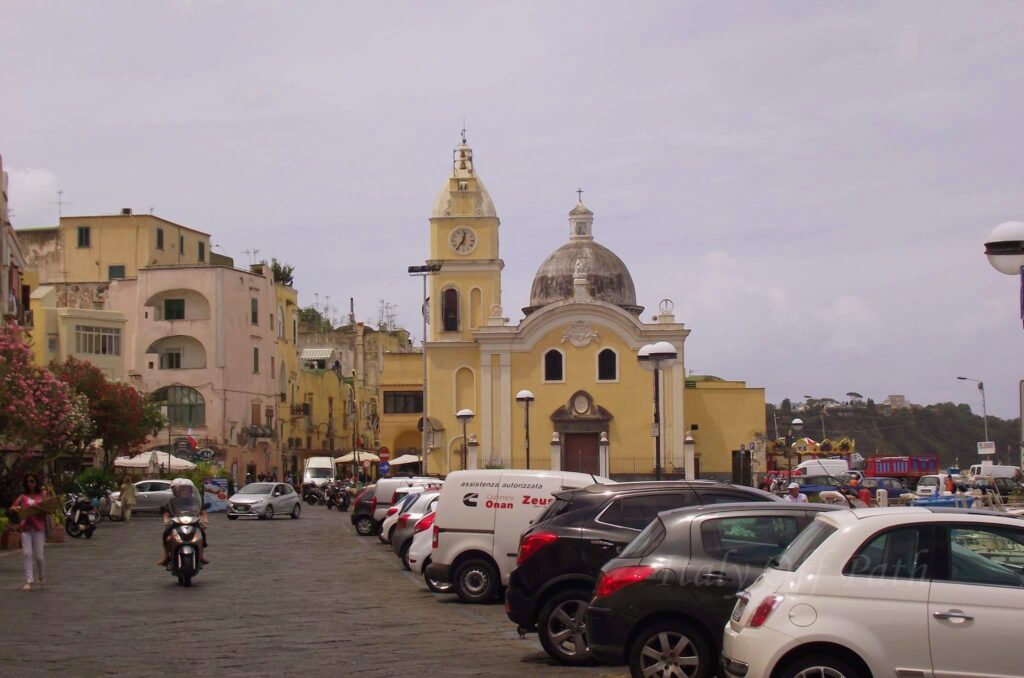
The central part of the island of Procida is Ciraccio and Piazza Olmo, from which many small streets lead to various interesting places, for example, the Church of St. Anthony on Via Vittorio Emanuele II. If you like cemeteries, on Via Cavour, behind the church, you can see the local one.
Marina Corricella – Procida’s Postcard-Perfect Fishing Village
Marina Corricella is an absolutely charming fishing village. With its colourful houses arranged in an amphitheatre by the sea, the green and blue nets lying on the quay, the colourful fishing boats, and the absence of vehicles, Marina Corricella gives the impression of a different world. The architecture of the 17th-century port is magnificent: an interweaving of arches, domes, windows, staircases, terraces, and colourful façades.
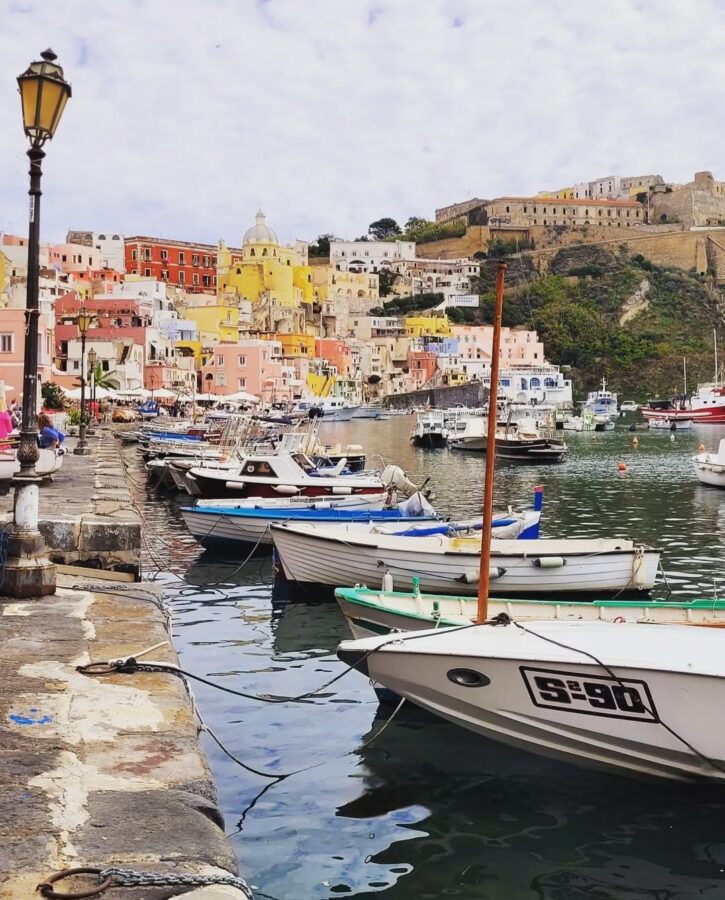
It’s a truly relaxing place, and even the presence of bars and restaurants doesn’t disturb the tranquillity. I believe you can simply spend hours there just sitting, looking at the sea, boats, or people passing by.
You can reach Marina di Corricella:
On foot: Walk through the narrow streets of Via Vittorio Emanuele, Via Principe Umberto, Piazza dei Martiri, and San Rocco, or another narrow street via Bernardi Scotti Galletta. The distance from Via Roma is about 1 km.
By bus: line C2 (EAVBUS), which goes to San Rocco; Marina di Corricella is just a stone’s throw away.
Or just take a taxi.
Terra Murata- The Island’s Oldest Settlement with a View
This is the highest point, the historical and cultural centre of the island, with a beautiful view of the Bay of Naples. It was also the first inhabited place on Procida, where the inhabitants, rightly not wanting to be slaughtered by the Saracens, sought refuge. Over time, visits from these troublesome and murderous guests became so frequent that investments were made in the construction of defensive walls.
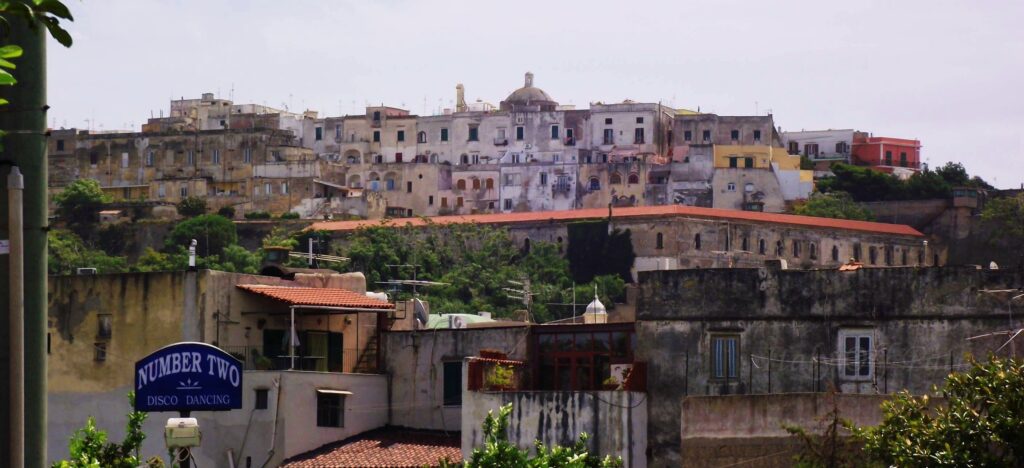
In the centre of Terra Murata stands the Palazzo d’Avalos, which was at times a royal palace throughout its history and, later, a prison. In the 1980s the citadel was closed; however, you can visit it with a guide. Since we didn’t have tickets and the crowds were huge, we saw the citadel from the outside.
The same happened with the Church of Santa Maria delle Grazie Incoronata. We didn’t get inside because of a very long queue, but I saw it 10 years ago, and I doubt any spectacular changes have taken place in the church building, so I didn’t regret it. Instead of visiting the church, I feasted my eyes on the view of the sea, Corricella, and Terra Murata from the church square.
Abbey of San Michele Arcangelo & Monastery of Santa Margherita Nuova
Abbey of San Michele Arcangelo
You will immediately spot this over-thousand-year-old Benedictine abbey, clearly visible as it rises approximately 91 meters above sea level. The oldest part of the building dates back to the 15th century; the abbey is known for housing an ancient book in its library, dating back to 1534.
Monastery of Santa Margherita Nuova
This also very old place is located halfway between the village of Corricella and Terra Murata. The monastery, this time Dominican, came to life as a result of Saracen invasions – the monks were simply fed up with the unpleasant guests and decided to move in.
Casa Graziella Museum – A Tragic Love Story with a Moral conclusion.
This reasonably new place, compared to the long history of the island, with an international tragic romance in its background, is located on the second floor of the Palazzo della Cultura in Terra Murata.
The story, with a moral: don’t fall in love with a foreigner, goes like this:
One fine day in 1811, the 21-year-old French poet and writer Alphonse de Lamartine arrived in Italy and spent 14 months on the island, where he fell in love with a local orphan, Graziella. This is what actually happened. In 1849, Lamartine wrote his love story in a romantic novel, naturally altering the story to make it more tear-jerking. In his novel, Graziella is the daughter of a local fisherman with whom Lamartine stayed on the island.
The beautiful, naïve, and simple girl makes the Frenchman’s heart beat faster, and he blushes at the sight of her. Feeling a surge of affection for Graziella, Alphonse abandons his refined French style (including his high-end wardrobe!) and decides to become a part of the simple life and local culture. The enamoured Frenchman from a distinguished family begins dressing like a fisherman and spends time on the island, meeting Graziella, working together, and reading love letters. Well, he came from a wealthy family, so I suppose Graziella did all the jobs, and the sighing Frenchman followed her with loving eyes — but in the book, they worked together.
This idyll is interrupted by his unexpected departure for France. Alphonse promises his beloved that he will return to her as soon as possible. Graziella, longing for the Frenchman, falls ill with tuberculosis. Sensing she is dying, she sends him a farewell letter containing a lock of hair. Two hundred years after the end of the love story, the moved association “La Casa di Graziella” decided to open a museum whose mission is to promote the history and culture of Procida through the eyes of Graziella — the girl who died for love.
Other Sights – The Lighthouse, Vivara Island, and Other Corners Worth Seeing
Faro, with its old lighthouse, is located behind the Marina Grande harbour – from there you’ll admire a magnificent panorama of the sea and the surrounding coastline. And you’ll breathe in the fresh, iodine-rich air.
Vivara Island
The island, designated a nature reserve in 2002, is currently closed to visitors, but when it’s open (May to October), be sure to visit it. Vivara, the remains of a volcanic crater, is shaped like a crescent moon. Its main inhabitants are small animals – rabbits. They are a legacy of the King of Naples, Charles. Apparently, the bunnies outlived the king, who died a long time ago, leaving behind a single building and gangs of rabbits hopping here and there.
Vivara Island is connected to Cape Santa Margherita (Marina Chiaiolella) by a footbridge.
Since the streets of Procida were crowded, we decided to visit the beaches.
Procida Beaches – Where to Swim, Sunbathe, and Watch the Sunset
The beaches on the island are small and sandy, but the sand is darkish. We reached two of them, and because it was a nice day, we spent some time soaking our feet in the water and basking in the sun.
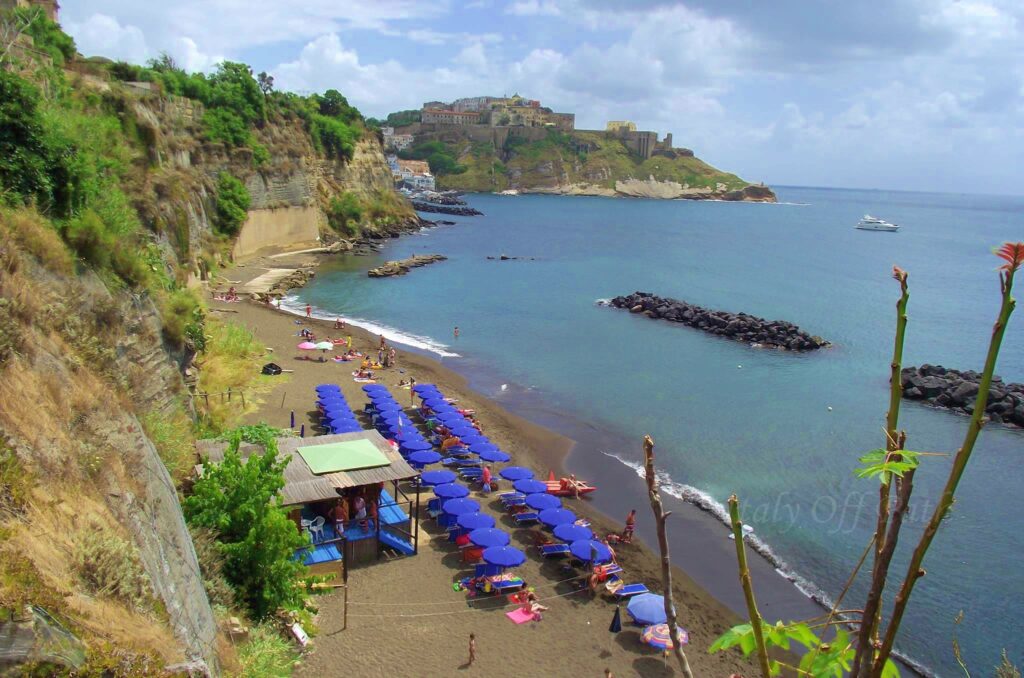
Ciraccio (Chiaiolella) Beach, separated from Ciracciello Beach by a rock slide, is nice, quiet, and sunlit all day long. You can get to Ciraccio in 15 minutes from Marina Grande by bus L1 or L2. What’s cool there is that you can hide in the shade; the water is nice and clear, and you can rent a kayak or a water bike. The cherry on the cake is Ischia, which you can see from the beach.
Ciracciello, on the other hand, is the longest stretch of sand on the entire island, which is why there are bars there. Ciracciello offers both paid and free beaches.
Spiaggia di Silurenza is about a 5-minute walk from the port of the island, Marina Grande, along Via Roma. As with most beaches, you can pay for a sunbed or lie on your own towel for free. The beach has quite decent infrastructure, which is why it is popular, especially with parents and children.
Chiaia Beach, near Marina di Corricella – you can take the L1 or L2 bus from Marina Grande. After about 10 minutes, get off at the stop near the ochre building with a path leading down to the beach. Chiaia is situated in a bay with beautiful views of the sea and the Sorrento Peninsula. It’s really great for families with children, as the water is nice and shallow and there are good facilities for lunch and snacks.
Pozzo Vecchio or Spiaggia Il Postino – you can walk there from the port, and it takes about 30–40 minutes. Get off at the “Cimitero” stop on the C1 bus (the exit to the beach is just behind the cemetery).
Il Postino is the most famous beach, probably because of its connection with the film “Il Postino”; some scenes were filmed there. Pozzo Vecchio is small and pebbly, surrounded by cliffs, with a quiet and relaxing atmosphere. The water here is incredibly clear and turquoise, perfect for swimming and diving. Stay there until sunset, because it’s worth watching this spectacle.
Where to eat
Time flew by, so quite late (as for Italy), we remembered to have lunch. Mauro, being a typical Italian, had to compare the menus of all the possible restaurants. Finally, we had a late lunch at Ristorante L’Approdo near Marina Grande.
Of course, Procida is famous for its fish and seafood, but you can find other dishes. Procida, like the rest of this part of Campania, is lemons, so pasta with lemon is often found on the lunch and dinner menu. Also, a variety of lemon-based desserts and sweets are available in bars and cafés. These local specialties are worth trying.
Returning to Naples – A Ferry Ride You Won’t Forget
The ferry to Naples was around 5:30 p.m.; while waiting for the ship, we observed a growing crowd of people waiting to be transported. It looked like the port was under siege.
If you have ever been to (southern) Italy, you may know that Italians are not the most polite people in the world. They rarely stand in line, push, disregard the rule that exits have priority, throw people to the entrance/exit, etc. Quite annoying. The embarkation looked like people being evacuated from a war zone. Everyone was pushing to get on the ferry and take a seat. It is not the first time I have seen Italians on board (e.g., by plane), and it is always the same. Anyway, we got on and were lucky because we managed to find seats too.
The ferry from Naples took 1 hour 30 minutes, so not long, but we also had to go back to Pozzuoli. And that was quite funny. I definitely think Italy is for drivers/tourists only. I don’t want to keep complaining about the lack of information, signs, or public transport, but I will. We couldn’t find the bus stop to Pozzuoli; theoretically, it was at the port, but nobody knew where. We ran back and forth looking for it; in the end, we decided to take the train (Circumvesuviana), which was leaving from the station 8 km away from the port. But there were no taxis…
I’m sure it was the quickest run/walk of my life, as it was the last train. Hallelujah, not only did we make it, but I also lost at least 3 kg thanks to it! We got to Pozzuoli and rode back to Manfredonia.