
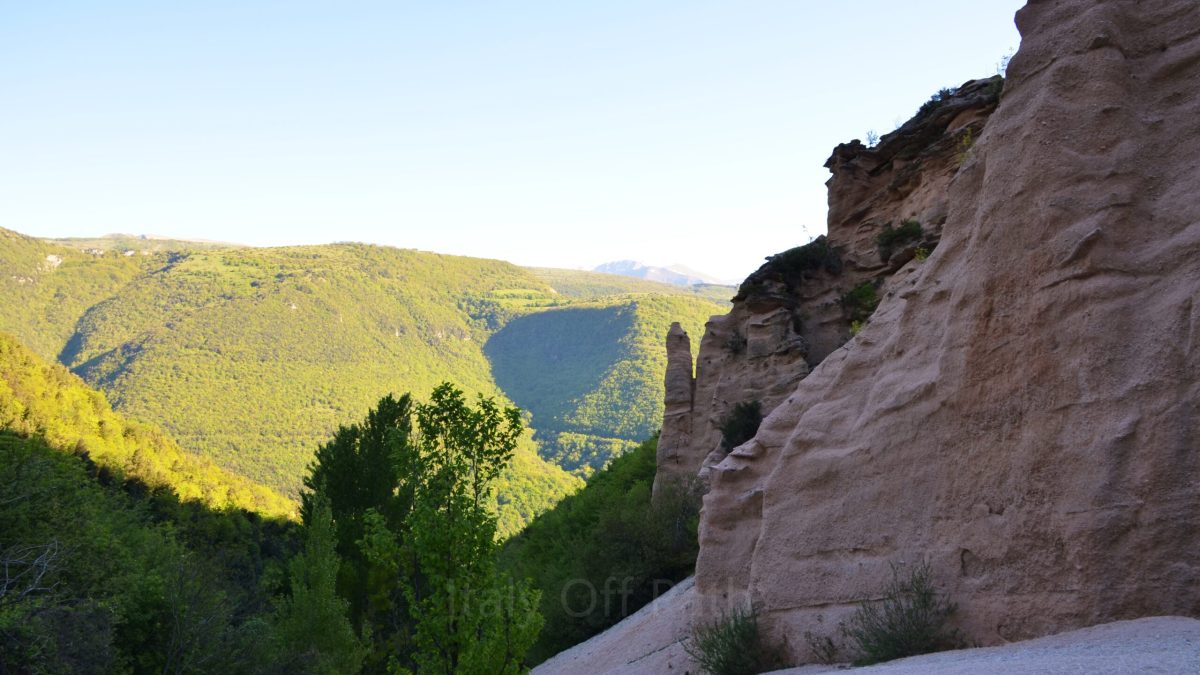
When you Google Lame Rosse in Marche, the first thing you read is that it’s the “Grand Canyon of Italy.” Well, don’t expect anything Arizona-like; you’re in Italy, not the US.
After the 6 km of the Lame Rosse Marche hike, I can assure you that this silly tendency to compare something incomparable usually has nothing to do with what you will see.
Lame Rosse in Marche – general information:
Trail length: approx. 7 km round trip (starting from the Diga di Fiastra dam).
Time: 2.5 – 3 hours (depending on your pace on the final ascent).
Difficulty: Easy, except for the last 15 minutes (a steep climb over scree).
Elevation gain: approx. 200 m, with the final section reaching a slope of around 45%.
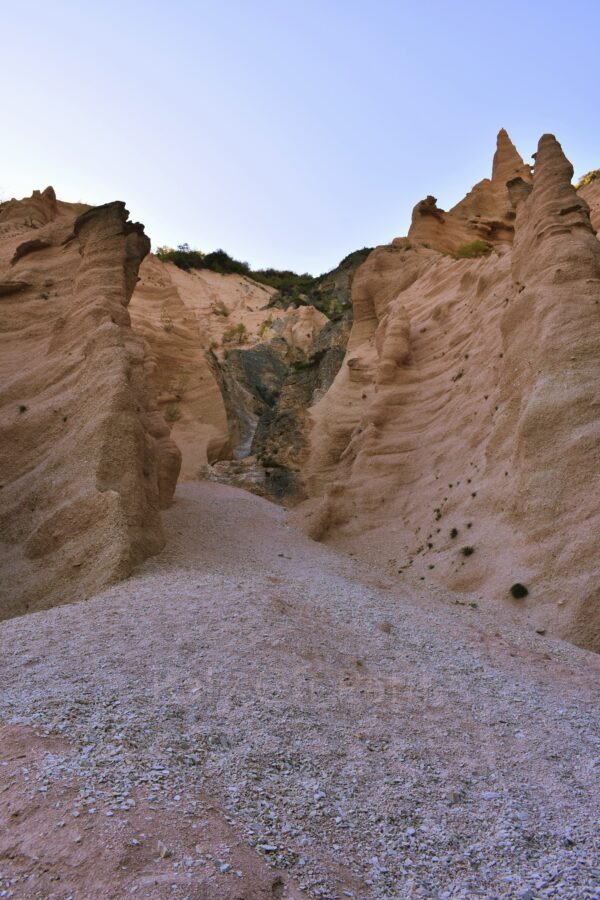
The only thing Lame Rosse has in common with the Grand Canyon is the striking red, iron-oxide colour, which depends on the lights actually, and the fact that both were formed by erosion. This a 2 to 3-hour trek near Lake Fiastra transitions from an easy forest path to a steep, 40-45% gradient scree slope. It’s impressive, but it’s its own thing—not a small-America.
Planning Your Trip: Lake Fiastra to Lame Rosse hike
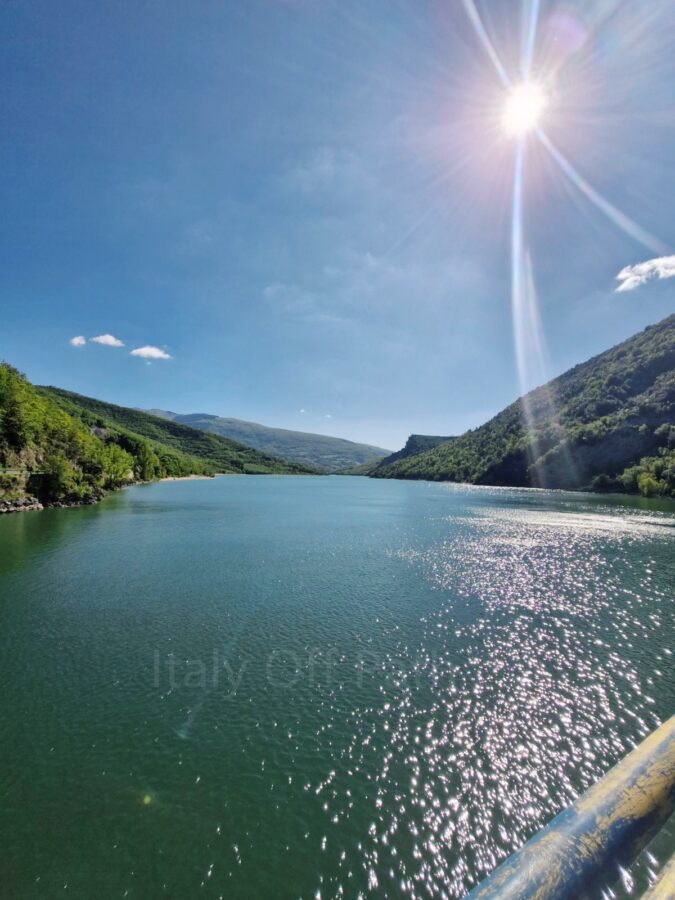
The Lame Rosse trail starts close to an artificial Lake Fiastra created by building a solid dam. We decided to see the ‘Mini Grand Canyon of Italy’ on Saturday in the so-called ‘ long weekend’ (Primo Maggio). The lake is obviously a popular spot – in the summer you can swim in it, and during the year, if the weather is nice, as it was on Saturday, you can enjoy picnics and so on.
That’s why there were many people and many cars – it took us a while to find a free parking space in Lame Rosse parking dam. Even though we arrived there after 2 pm, so in theory Italians should enjoy their lunch in restaurants – but evidently not that day. We parked, as many other drivers, on the side of the road. I believe during the week it would be easier.
Lame Rosse Marche hike: 7 Hours or 7 Kilometres?
Parked, we wore hiking boots, packed water (since there are no fountains on the trail), took hiking poles – which were partly useful, and started the 6 km long trail.
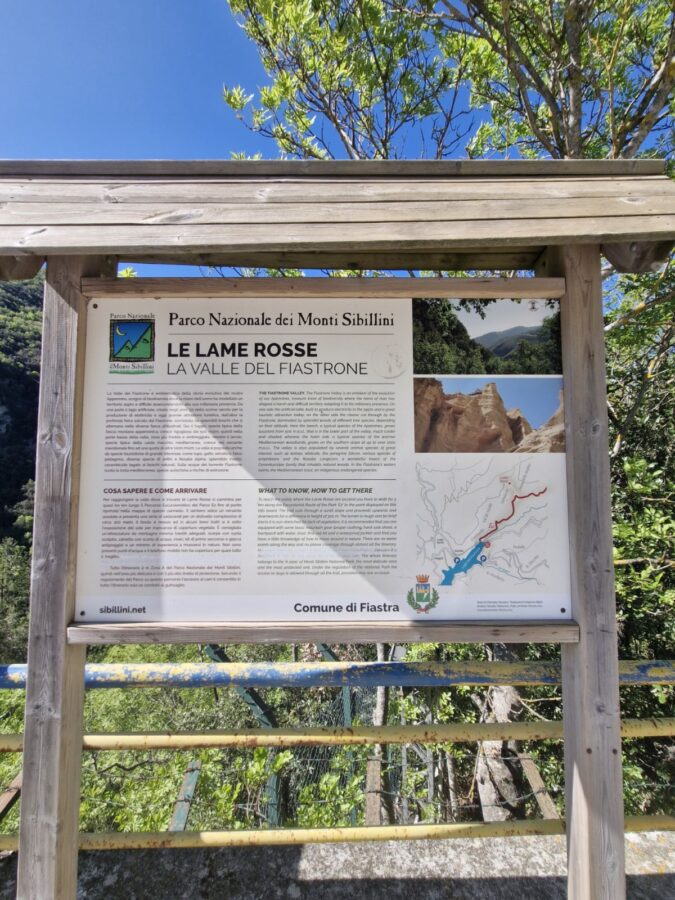
Mauro had read on one of the trail websites that it might take 7 hours; we were a bit sceptical, because it meant 850 m/hour. Climbing Lame Rosse then should be as difficult as at least climbing K-2 or so.
We were also a little worried because we had set off late and it would be dark by the time we got there. We crossed the dam Diga di Fiastra – that’s how the Lake Fiastra to Lame Rosse trail starts- then we passed a short tunnel and took the rocky/ gravel path.
There’s only one trail, so no chance to get lost. After walking a few minutes, we started meeting people going down – some of them were with children, others with dogs. Still believing the information we saw online, I thought that maybe they just walk around, especially since almost all wore trainers.
Walking up, we went into the forest. The path was still up, as it should be in the mountains. I started using my hiking poles, but just because I had taken them with me – the path was easy.
Avoiding the Swarms: The “Sacred Lunch” Strategy
Mauro noted that in roughly an hour, we had covered the section that was supposed to take nearly two. More and more people were going down – it meant that there wouldn’t be crowds close to the Lame Rosse – it’s simply a main benefit of arriving late. Lunch is a sacred stuff in Italy, so if you want to avoid swarms, either get to your destination at the crack of dawn or start when everyone else sits down to eat.
The Final Climb: Navigating the 45% Scree Slope (Ghiaione)
Finally, we reached the last section of the trail. I looked up at a rather steep mountain ahead, probably around 40-45% grade, with a gravel slope.
My first thought was – the final climb to Lame Rosse would be funny, especially the descent. This type of terrain is quite treacherous – it’s easier to go up than down.
Watching people in trainers trying not to slip and stay on their feet descending Lame Rosse, I started walking up – here the hiking poles were useful.
Unlike most people, we chose the shoulder of the mountain—close to the bushes—for our ascent and descent, as there were plenty of stones. It was easier to find a grid, even so we did slip occasionally.
Photography at Lame Rosse: Why Mine Aren’t “Rosse”
Hiking around the Lame Rosse, we climbed further up inside the canyon. There, the formation is even more impressive, but also steeper and more difficult to reach. We saw a path there between the rocks, so if somebody wants, it’s possible to get alternative views of Lame Rosse.
Taking pictures of this Marche conglomerate formations, we planned to wait until the sunset – this and early morning are the best time of day to photograph Lame Rosse, as they are red. But the rumbling in our empty stomach decided for us – hungry, we decided to go down, and my Lame Rosse is not so rosse (red) in the pictures.
The Verdict: Is Lame Rosse Actually Worth the Climb?
Honestly, I still can’t decide if I liked Lame Rosse. Maybe it’s because I was expecting something more spectacular based on what I saw online. I usually go to places without any expectations, but for this place, which I really wanted to see, I probably built up a bit of them. And that was a fault.
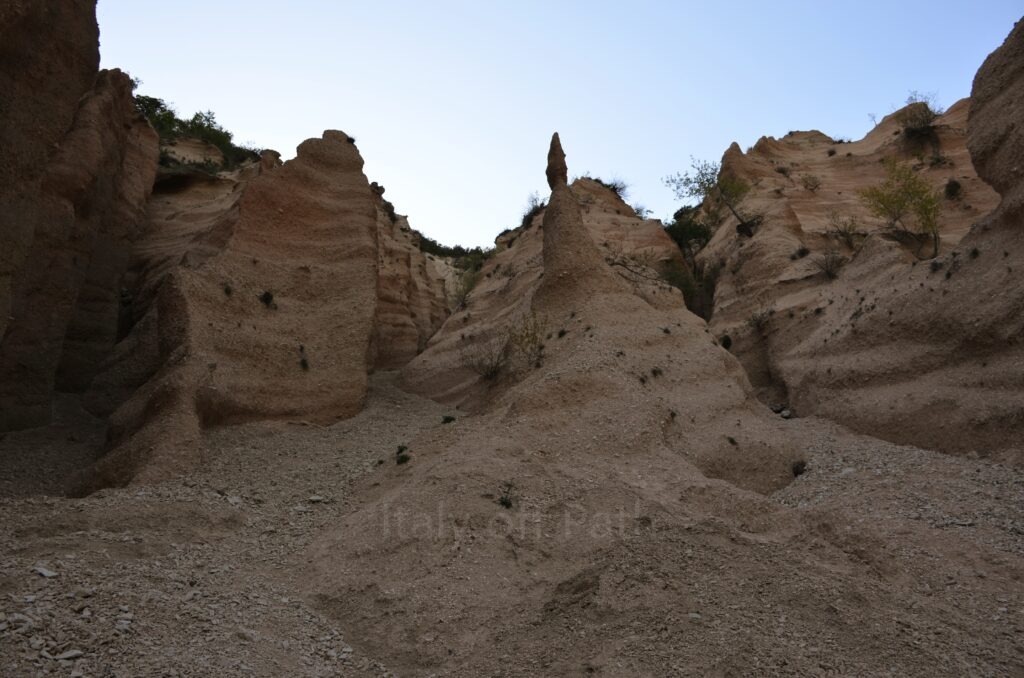
Having been to a lot of places, I’m also quite spoiled, so sometimes I don’t get that “wow” moment anymore (a side effect of travel). Lame Rosse isn’t the Grand Canyon or Cappadocia (has anyone come up with that comparison yet?); it’s a interesting formation that looks even more striking in certain lighting. And yes, it’s worth the climb even just for the experience.
Practical Tips for Lame Rosse in Marche Hike
How to avoid crowds: Visit during the week or at the crack of dawn. If you’re there on a weekend, start your hike during the lunchtime window (around 1:00 pm – 2:00 pm). While the “sacred” Italian lunch is happening, the trail clears out significantly.
Parking at Lake Fiastra: Arriving early or during the lunch lull makes finding a parking space at the Fiastra dam (Diga di Fiastra) much easier. If the main area is full, you will likely end up parking on the side of the road like everyone else.
The Child/Teenager Rule: Don’t be fooled by the “family-friendly” tags online. I wouldn’t take small children (toddlers) here. Unless a child is a teenager or experienced in mountain trekking with parents, the final climb is too unstable. It isn’t a place for children who can’t managed their own balance.
Is Lame Rosse dog-friendly? Yes, it is, and you’ll see plenty of dogs on the path. Just remember that while the first 80% is a breeze, the final scree slope (ghiaione) is sharp and sliding. It can be tough on a dog’s paws if they aren’t used to mountain terrain.
Footwear: Wear hiking boots with a deep-tread (lugged) sole. You can reach the top in trainers—almost everyone we saw was wearing them—but it’s a recipe for a slide. It’s simply not the best choice for this mountain.
Master the scree slope (Ghiaione): The final climb is almost 45% gradient mountain of loose gravel. Do not walk up the middle of the slope; it’s the steepest part and lacks any solid grip.
Use the “Shoulders”: Stick to the edges (the shoulders) of the trail where there are more large stones. It is much easier to find a grip and secure your feet there.
Protect your knees: If you aren’t an experienced hiker or have knee problems, descend sideways (side-stepping). It takes the pressure off the joints and provides more stability.
The “Scree Run”: If you have the practice and the balance, you can actually jog down the descent. Sometimes moving with the gravel is easier than fighting it—just make sure you know what you’re doing.
Water and Facilities: There are no water fountains or toilets on the trail. Pack enough water for a 6 km round trip for yourself and your dog, especially in the summer.
The Reality Check: The Lame Rosse trail is an easy trail, until the last 15 minutes.
Best Season to Visit: Stick to spring and autumn. I would avoid the trail during or immediately after heavy rain; this is a general rule for the mountains, but especially true here where the clay and gravel turn into a slide.
Winter Warning: Avoid the trail in winter, particularly if there is snow.
Sun Protection: Lame Rosse is a shadowless place. There is no shade on the final climb, so wear a hat and sun protection.
- It’s prohibited to touch or climb the Lame Rosse formations.
If this post made you laugh, annoyed you, or just reminded you of your own trip, tell me in the comments or drop me an email. I actually want to hear about your experiences—the good and the frustrating.
Sign up for the newsletter for one post a week (usually Wednesdays at 6:00 PM). No spam, no “magical Italy” fluff. Just honest stories and places off the beaten track. I’ll see you there!